

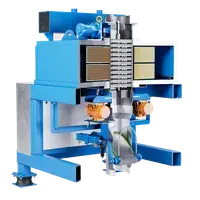
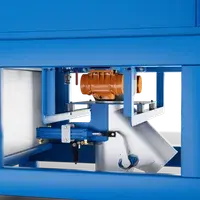
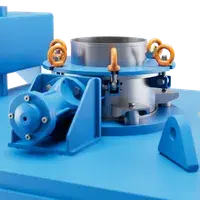
Features

Variable magnetic field strength for separation optimization.

Processes particle sizes from 45 microns (0.0018 in) to 2 mm (0.079 in) for ceramics, recycling, and other mineral applications.
Handles mineral feed temperatures up to 80 °C (176 °F) for demanding industrial processing.
- About
- Benefits
- Operation
Induced Roll Separation for Weakly Magnetic Minerals
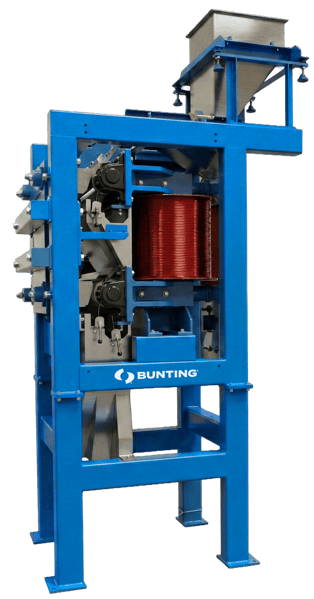
Bunting induced roll magnetic separators remove weakly and moderately magnetic particles from dry, nonmetallic minerals. The electromagnetic system produces an adjustable field up to 2.2 T (22,000 gauss), separating materials such as mica and iron-coated silica from feldspar, silica sand, zircon, and other nonmagnetic minerals.
How the Induced Roll Separator Works
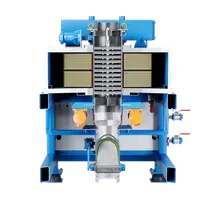
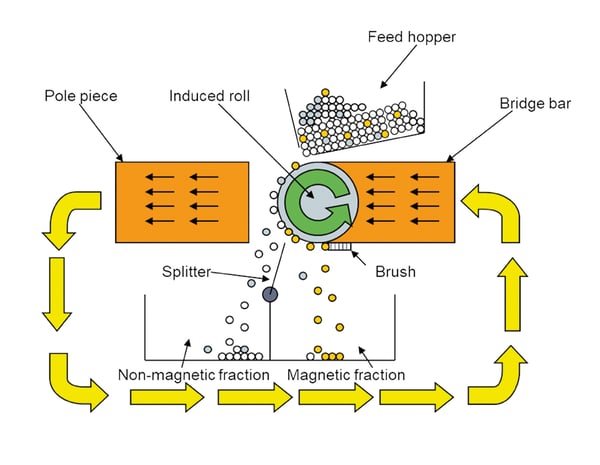
- An electromagnet magnetizes the steel roll between the bridge bar and pole piece.
- Dry material is fed across the roll, where magnetic particles are held and separated from the nonmagnetic product.
- Field strength can be adjusted to suit the mineral and required separation.
Operating Range
- Particle sizes from 45 microns (0.0018 in) to 2 mm (0.079 in)
- Feed temperatures up to 80 °C (176 °F)
- Continuous processing of dry mineral feeds
Common Applications
- Purifying raw materials for ceramics and glass
- Removing mica and iron-coated silica from industrial minerals
- Recovering fine, weakly magnetic particles in recycling processes
Contact Bunting to test your material and determine the appropriate field strength and roll configuration.
Adjustable Magnetic Field: Power to the electromagnetic coils can be varied to match material characteristics.
Variable Roll Speed: Allows fine-tuning of retention time for improved separation accuracy.
Customizable Roll-to-Pole Gap: Accommodates different feed size ranges for optimal processing.
Handles Heated Material: Capable of processing materials at elevated temperatures up to 80°C.
Minimized Static Charge: Generates limited static buildup, reducing impact on separation performance.
Durable Construction: Engineered for minimal maintenance and low spare parts requirements.
Material Feeding:
- A controlled amount of material is fed onto the rotating magnetically induced roll.
- The material feeds from a hopper or vibratory feeder.
- The roll typically rotates at speeds between 80 to 120 RPM.
Separation Process:
- Paramagnetic materials are held to the roll surface.
- Non-magnetic materials fall freely, unaffected by the magnetic field.
Material Collection:
- Non-magnetic materials discharge away from the roll.
- Magnetic materials are deflected by the roll.
- A brush often helps remove the magnetic materials from the roll.
Separation Control:
- A splitter plate is placed between the two product streams for clean separation.
- A second splitter can be added to create a 'middlings' stream (very weak magnetic materials mixed with non-magnetics).
Enhanced Efficiency:
- Many units have two induced rolls in series.
- This allows for a double pass, improving separation efficiency and overall performance.

Want To Know More?
For more information, we encourage you to browse our website to view our extensive range of products, and to contact one of our sales representatives to discuss your specific needs and interests.