

Application guidance: Recycling plants maximize metal recovery by combining magnetic separators and eddy current separators throughout the process. Overband magnets, drum magnets, eddy current separators, and stainless steel separators each perform a different role in recovering valuable metals and improving product purity.
Which magnetic separators do recycling plants use to maximize metal recovery? The answer is rarely a single machine. Modern recycling facilities use multiple separation technologies positioned throughout the process to recover ferrous metals, non-ferrous metals, and stainless steel while protecting equipment and improving product quality.
Whether processing municipal solid waste (MSW), construction and demolition waste, commercial and industrial waste, auto shredder residue, electronic scrap, wood waste, RDF, or SRF, the objective is the same: recover as much valuable metal as possible while producing cleaner recycled commodities.
Most recycling operators achieve the highest recovery rates by combining magnetic separation equipment with eddy current separation technology at multiple stages of the process.
Contents
- Why Metal Separation Matters in Recycling
- Which Separators Are Most Common in Recycling Plants?
- Overband Magnets for Primary Ferrous Recovery
- Drum Magnets for Continuous Ferrous Recovery
- Eddy Current Separators for Non-Ferrous Recovery
- Stainless Steel Separators for Additional Recovery
- Magnetic Head Pulleys for Secondary Clean-up
- Typical Recycling Plant Layout
- Separator Comparison Table
- How to Select the Right Separator
- Frequently Asked Questions
Why Metal Separation Matters in Recycling
Metal recovery is one of the most important value-generating stages in many recycling operations. Ferrous metals, non-ferrous metals, and stainless steel all have commodity value, while metal contamination can reduce product quality and damage processing equipment.
Effective separation systems help recycling plants:
- Increase revenue from recovered metals
- Improve product purity
- Reduce landfill volumes
- Protect shredders, crushers, and screens
- Lower maintenance costs
- Improve downstream sorting efficiency
- Increase plant throughput
Different metals require different separation technologies. Large steel objects, aluminium cans, copper wire, and stainless steel fragments all behave differently in a recycling process.
Which Separators Are Most Common in Recycling Plants?
The most common metal separation systems used in recycling plants are:
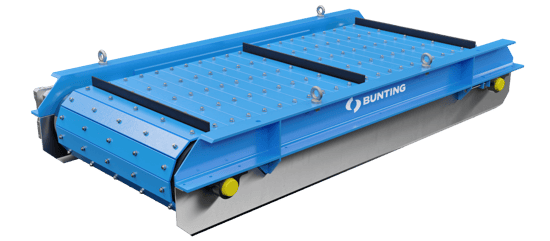
- Overband magnets for primary ferrous recovery
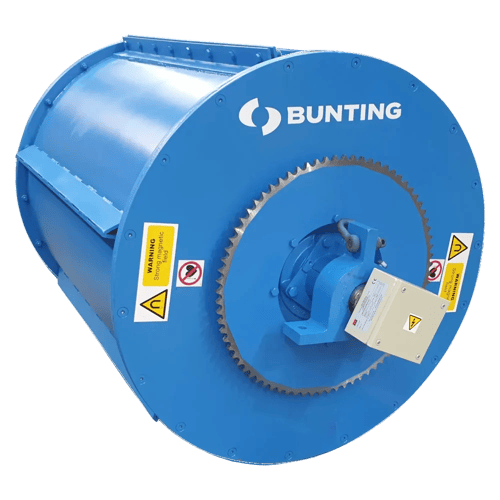
- Drum magnets for continuous ferrous separation
- Eddy current separators for non-ferrous metal recovery
_ECS200-VF_0001-1.png?width=600&height=392&name=High-Intensity%20Concentric%20(HIC)_ECS200-VF_0001-1.png)
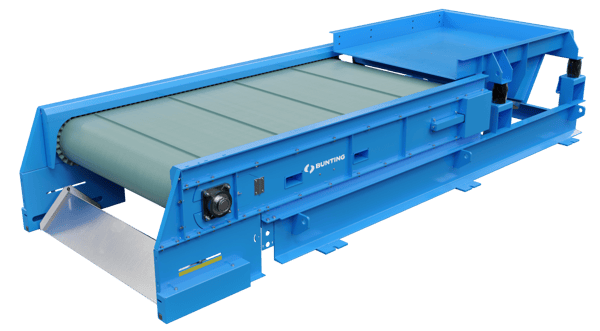
- Stainless steel separators for recovering weakly magnetic stainless steel
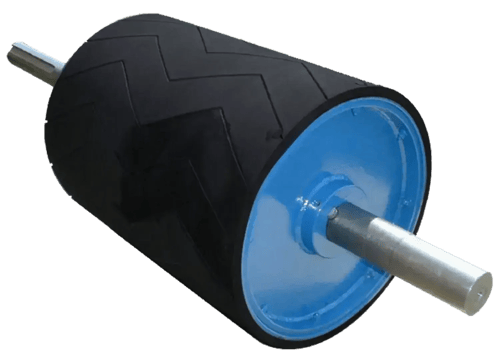
- Magnetic head pulleys for conveyor discharge clean-up
Each technology targets a different metal fraction and is typically installed at a specific point within the recycling process.
Overband Magnets for Primary Ferrous Recovery
An overband magnet is a magnetic separator suspended above a conveyor to remove tramp ferrous metal from conveyed material.
In recycling applications, overband magnets are commonly positioned after shredders, screens, bag splitters, or primary conveyors to recover large ferrous contaminants and protect downstream equipment.
Typical recovered materials include:
- Steel plate
- Rebar
- Structural steel
- Wire bundles
- Machine components
- Steel containers
- Large ferrous scrap
Electro Overband Magnets
Electro overband magnets generate a deep magnetic field and are commonly used on wider conveyors, deeper burdens, and high-capacity recycling lines.
For demanding recycling applications, many operators select the ElectroMax overband magnet due to its ability to recover large ferrous contaminants from deep material streams.
Permanent Overband Magnets
Permanent overband magnets use permanent magnetic blocks to generate the magnetic field and require no electrical power for magnetic performance.
These separators are frequently used on mobile recycling equipment and where simplicity and low maintenance are priorities.
Drum Magnets for Continuous Ferrous Recovery
A drum magnet provides continuous and automatic ferrous metal separation from bulk material streams.
After primary metal removal, drum magnets recover steel fragments and smaller ferrous particles that remain within shredded material.
Drum magnets are commonly installed:
- After shredders
- After screening systems
- Before density separation equipment
- Ahead of optical sorters
- Before eddy current separators
Because separation is continuous, drum magnets are particularly effective in high-throughput recycling facilities processing large volumes of material.
Learn more about drum magnets for recycling applications.
Eddy Current Separators for Non-Ferrous Metal Recovery
Once ferrous metals have been removed, recycling plants typically use eddy current separators to recover valuable non-ferrous metals such as aluminium, copper, brass, and zinc.
An eddy current separator uses a rapidly rotating magnetic rotor to induce electrical currents within conductive metals. These currents create a repelling force that ejects non-ferrous metals away from the material stream, creating a separation.
Eddy current separators are widely used in:
- Materials recovery facilities (MRFs)
- Municipal solid waste recycling
- Construction and demolition waste recycling
- Automotive shredding operations
- Electronic waste recycling
- Plastics recycling
- Incinerator bottom ash processing
For many recycling plants, the eddy current separator is one of the most important revenue-generating pieces of equipment because it recovers high-value non-ferrous metals that would otherwise be lost.
Stainless Steel Separators for Additional Metal Recovery
After ferrous and non-ferrous recovery stages, some recycling streams still contain stainless steel.
Although stainless steel is often considered non-magnetic, many grades exhibit weak magnetic properties that enable recovery using specialist stainless steel separation technology.
Stainless steel separators are commonly installed after eddy current separators to recover weakly magnetic stainless steel from residual material streams.
Applications include:
- Automotive shredder residue
- Electronic waste recycling
- Incinerator bottom ash processing
- Metal-rich waste streams
- Mixed scrap processing
Recovering stainless steel improves overall metal recovery rates and increases the value of recovered commodities.
Magnetic Head Pulleys for Secondary Ferrous Clean-up
A magnetic head pulley replaces a standard conveyor head pulley and provides an additional ferrous recovery stage at the conveyor discharge point.
As material leaves the belt, ferrous metals remain attached to the magnetic pulley while non-magnetic material follows its normal trajectory.
Magnetic head pulleys are typically used as a secondary clean-up stage rather than the primary recovery system in modern recycling plants.
They are particularly useful where:
- Space is limited
- Additional ferrous clean-up is required
- Product purity specifications are demanding
- A final magnetic separation stage is needed
A Typical Recycling Plant Metal Recovery Layout
| Process Stage | Typical Separator | Primary Objective |
|---|---|---|
| Incoming material conveyor | Overband Magnet | Primary ferrous recovery and equipment protection |
| Post-shredder processing | Drum Magnet | Continuous ferrous metal recovery |
| Non-ferrous recovery stage | Eddy Current Separator | Recover aluminium, copper, brass, and other conductive metals |
| Residual metal recovery | Stainless Steel Separator | Recover weakly magnetic stainless steel |
| Final clean-up stage | Magnetic Head Pulley | Secondary ferrous clean-up |
Metal Separator Comparison Table
| Separator Type | Primary Recovery Target | Typical Location |
|---|---|---|
| Overband Magnet | Ferrous metals | Conveyor transfer points |
| Drum Magnet | Ferrous metals | Post-shredder processing |
| Eddy Current Separator | Aluminium, copper, brass | After ferrous recovery |
| Stainless Steel Separator | Weakly magnetic stainless steel | After eddy current separation |
| Magnetic Head Pulley | Residual ferrous metals | Conveyor discharge |
How Do Recycling Plants Select the Right Separator?
The correct separator depends on the material stream, metal content, throughput, particle size, and recovery objective.
Key selection factors include:
- Material type
- Metal composition
- Particle size distribution
- Conveyor width
- Burden depth
- Throughput rate
- Required product purity
- Available installation space
- Maintenance requirements
Most successful recycling plants use multiple separation technologies working together rather than relying on a single separator.
Material testing and application assessment help identify the most effective separation strategy and equipment configuration.
Frequently Asked Questions
Building a Complete Metal Recovery System
Modern recycling plants maximize metal recovery by combining magnetic and non-magnetic separation technologies throughout the process. Overband magnets and drum magnets recover ferrous metals, eddy current separators recover valuable non-ferrous metals, stainless steel separators target weakly magnetic grades, and magnetic head pulleys provide additional clean-up where required.
The most effective solution depends on the material stream, recovery objectives, and plant layout. Bunting can assess your application and recommend the most appropriate combination of magnetic separation equipment for your recycling operation.
For application guidance and separator selection support, contact Bunting’s technical team.