

Updated October 2026. Revised for Bunting's current metal separation range, with more on purity and where each separator belongs in the line.
How MRFs and household waste plants recover steel and aluminium, and what keeps that metal clean enough to sell.
Short answer: Most MRFs and household waste plants recover ferrous metal early with an overband magnet, often followed by a drum magnet, then recover non-ferrous metal, mainly aluminium cans, with an eddy current separator after picking. How clean the recovered metal is depends as much on how material is presented to each separator as on the separator itself.
First published in Skip & Waste, October 2023.
Metal recovery and recycling from waste is not new, with evidence of such activity in Roman times. In modern recycling plants, metal recovery provides a vital financial lifeline. Bunting helps waste management companies maximise metal recovery while maintaining high purity levels.
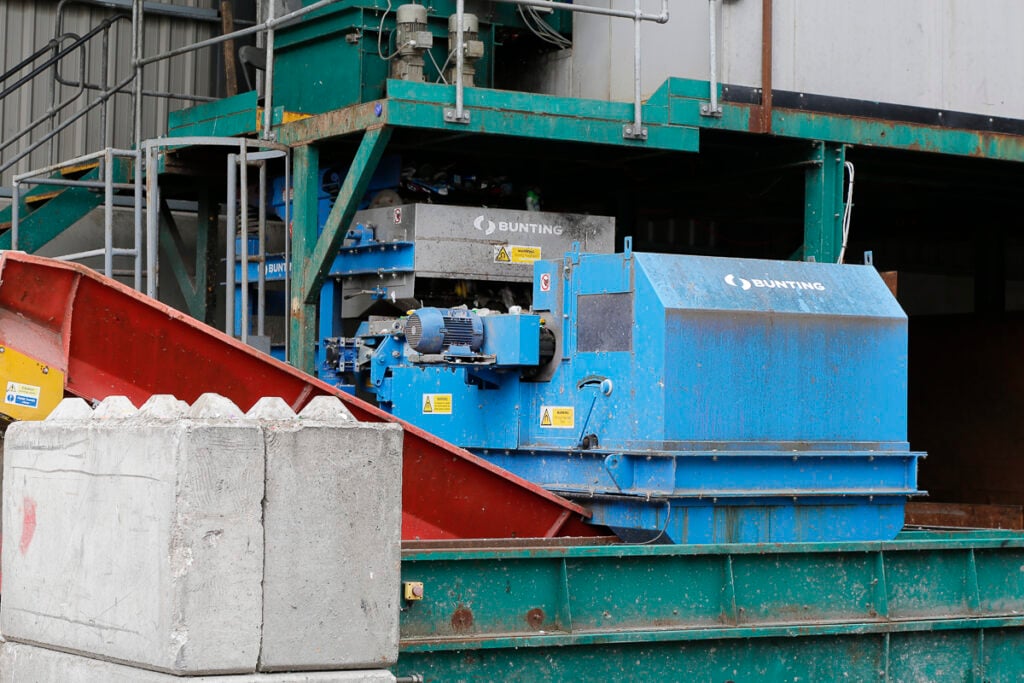
How do MRFs recover ferrous metal?
Ferrous metal, such as steel food and beverage cans, is commonly recovered early in the recycling process. Overband magnets, placed across or in line with the conveyor carrying the waste, attract the ferrous metal and automatically discharge it into a collection area. Low-throughput plants use permanent overband magnets, while large-volume operations, such as energy-from-waste plants, install larger electromagnets.
Permanent overband magnets
Suited to lower-throughput plants and shallower burden depths. No power supply for the magnetic field, and little maintenance.
Typical use: smaller MRFs and pre-sorted household waste lines.
Electro overband magnets
Suited to larger plants, deeper burdens and greater suspension heights, such as the ElectroMax.
Typical use: high-throughput MRFs and energy-from-waste plants.
A drum magnet further down the line can recover ferrous metal the overband missed, or clean the ferrous fraction further. For more on choosing between the two overband types, see Electro vs Permanent Overband Magnets.
How do MRFs recover aluminium and other non-ferrous metal?
The remaining non-magnetic material contains non-ferrous metal, predominantly aluminium beverage cans. High in value and demand, aluminium cans provide an excellent financial return when supplied at the optimum purity specification. An eddy current separator uses strong magnetic forces to propel aluminium cans off the conveyor and away from the mixed waste, into a separate collection area or onto another conveyor.
An eddy current separator is a two-pulley conveyor in which the non-metallic rotor cover houses an independently rotating, high-speed magnetic rotor. When a non-ferrous particle such as aluminium enters the magnetic zone, it is exposed to rapidly changing magnetic polarity. This induces eddy currents in the particle, which create a magnetic field of their own. The two fields oppose each other, repelling the particle and changing its trajectory. A carefully positioned splitter then separates the non-ferrous metal from the non-metallic material, using the difference between the altered and unaltered trajectories.
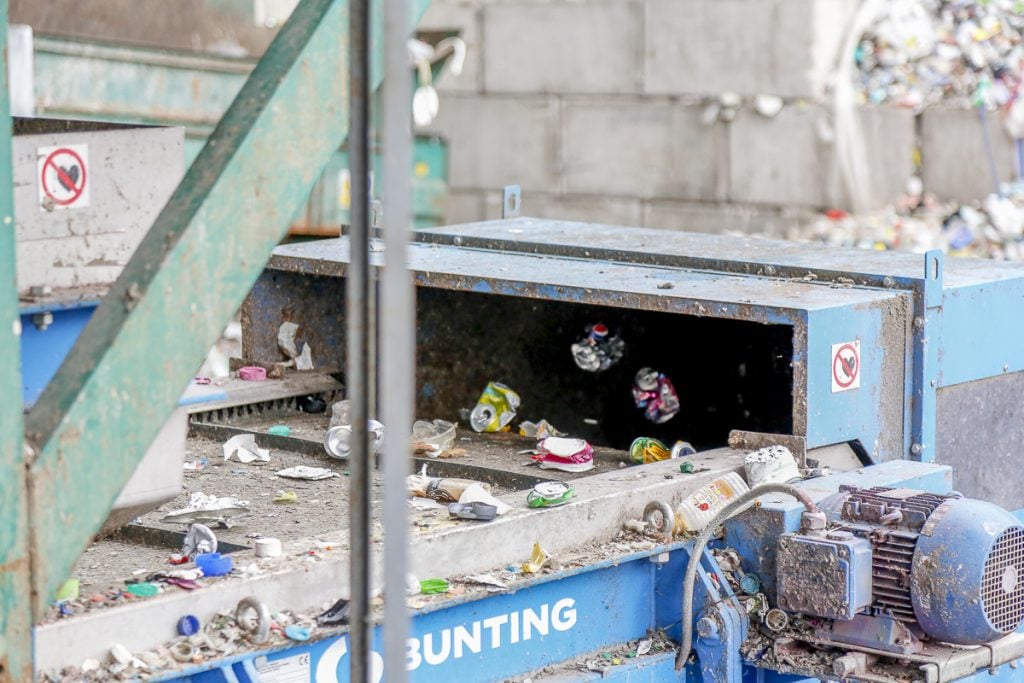
Remove ferrous metal first. Ferrous metal reaching an eddy current separator reduces separation and can damage the belt and rotor shell, which is why magnets sit upstream.
Where does each separator go in an MRF?
A typical sequence is shown below. Your plant may need more or fewer stages depending on the waste stream and the grades you sell.
Early in the line
Overband magnet
Lifts steel cans and other ferrous items out of the main stream before picking and screening.
Protects: downstream screens, the eddy current separator, and the purity of other fractions.
After the overband
Drum magnet
Recovers ferrous metal the overband missed, or cleans the recovered ferrous fraction.
After picking
Eddy current separator
Ejects aluminium cans and other non-ferrous metal from the remaining stream.
What affects the purity of recovered metal?
Most purity problems come from how material reaches the separator, not from a lack of magnetic strength. The main factors are:
- Burden depth. A deep or uneven burden can bury metal or carry non-metallic material with it.
- Feed presentation. A single, evenly spread layer gives each separator the best chance.
- Belt speed and throughput. These change trajectories at the eddy current separator and the time material spends under a magnet.
- Splitter position. Set too close, it lets residue into the metal; set too far, it loses metal to residue.
- Conveyor design. Steel idlers and frames under an overband magnet reduce its performance. See Ferrous-Free Zones Under Overband Magnets.
Testing with your own material shows what recovery and purity a separator can achieve before you specify it.
What does this look like on a real site?
At the Parry & Evans pre-sorted domestic refuse site in Deeside, UK, the combination of a Bunting overband magnet, drum magnet and eddy current separator recovers approximately 800 kg/hr of metal. That is a vital financial benefit in keeping the recycling operation viable.
Frequently asked questions
Which magnet is used to recover steel cans in an MRF?
Usually an overband magnet mounted over the conveyor early in the line, often followed by a drum magnet to recover any ferrous metal it missed.
How are aluminium cans separated in an MRF?
An eddy current separator after picking ejects aluminium cans and other non-ferrous metal from the stream, and a splitter divides them from the remaining material.
Why does ferrous metal have to be removed before the eddy current separator?
Ferrous metal reduces separation and can damage the belt and rotor shell, so magnets are placed upstream.
How can an MRF improve the purity of recovered metal?
Control burden depth, spread the feed evenly, set belt speed and splitter position for the material, and keep steel structure away from overband magnets. Testing with your own material confirms what each separator can achieve.