
Updated October 2026. Revised for Bunting's current metal separation range, with the flowsheet set out stage by stage.
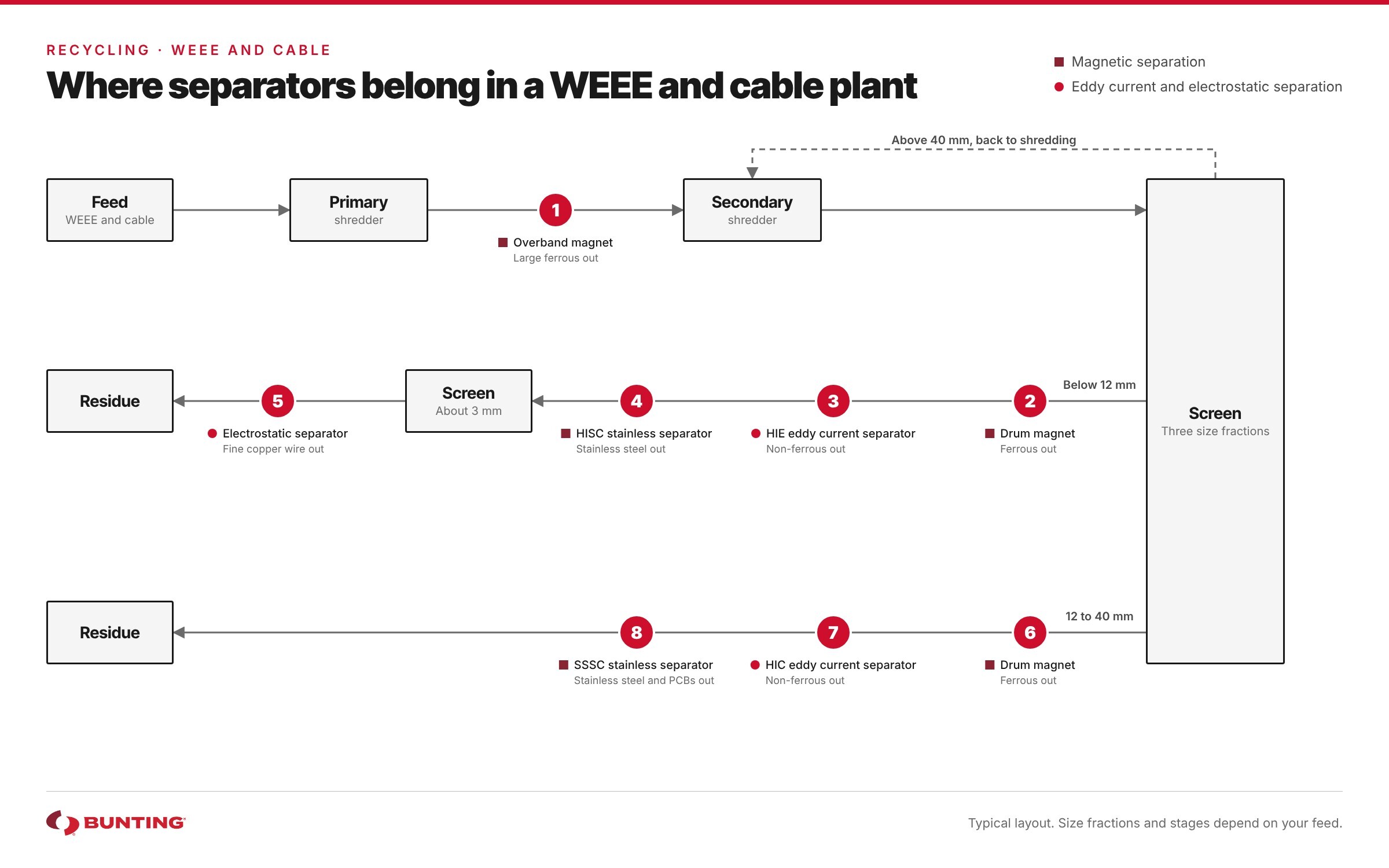
A typical flowsheet for recovering ferrous metal, non-ferrous metal, stainless steel and fine copper wire from shredded WEEE and cable.
Short answer: WEEE and cable are shredded to liberate the metal, screened into size fractions, then passed through several separation stages: magnets for ferrous metal, eddy current separators for non-ferrous metal, high-intensity magnetic separators for fragmented stainless steel, and an electrostatic separator for fine copper wire. A typical flowsheet produces seven saleable fractions.
There is a wealth of valuable metals present in WEEE (Waste Electrical and Electronic Equipment) and cables. However, recovery is often difficult due to the small particle size range and variable nature of the metals. Bunting provides a complete multi-stage metal separation solution, combining several separation techniques to maximise metal recovery from complex waste streams. This article reviews a typical WEEE flowsheet and the optimum location and design of the separation equipment.
Why does metal liberation matter?
Successful metal liberation is critical to maximise recovery. This flowsheet shows one primary stage of shredding, although a secondary stage is common before screening.
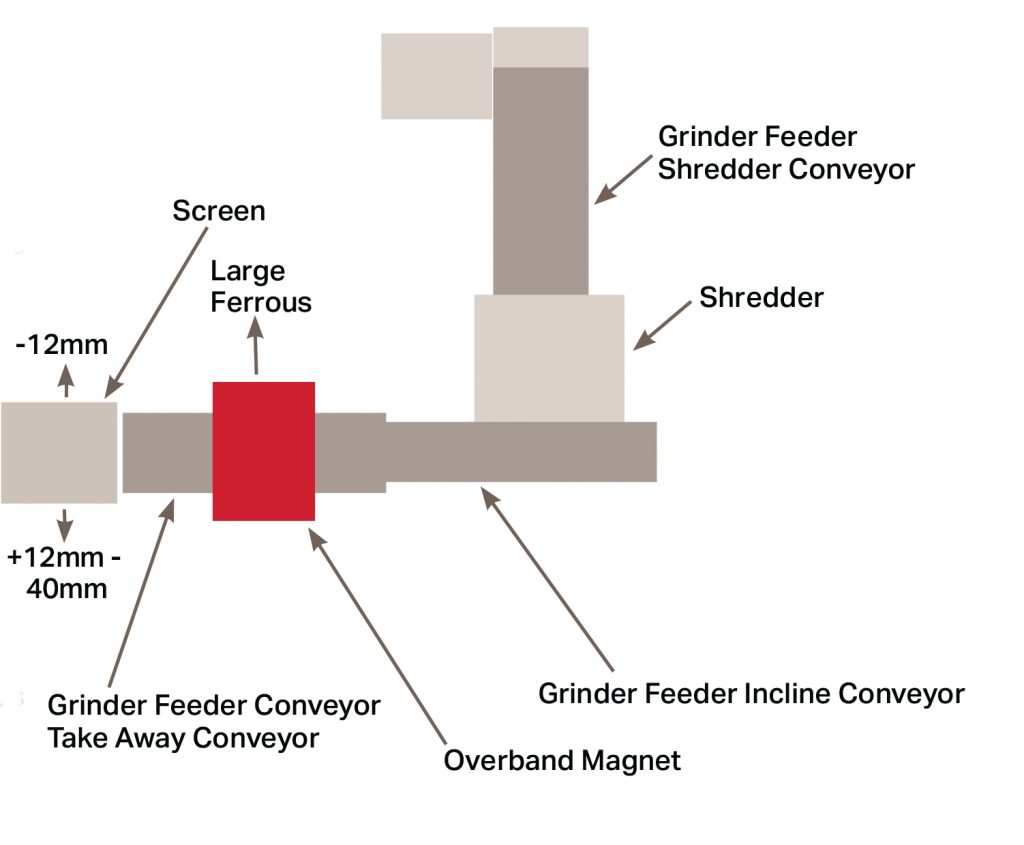
Even with two stages of shredding, a self-cleaning overband magnet is commonly located on the exit conveyor from the primary shredder to recover larger ferrous metal. Removal at this stage also reduces the load and wear on the secondary shredder.
The self-cleaning overband magnet has a slatted rubber discharge belt revolving around two outer pulleys, and an internal permanent or electro magnetic block. The magnetic block attracts and lifts ferrous metal from the conveyor, and the discharge belt automatically transfers it into a collection area. Both permanent and electro overband magnets recover ferrous metal, with models such as the ElectroMax giving enhanced separation at higher suspension heights.
Why is particle size control so important?
Optimum metal separation requires careful particle size control, which enables both higher metal recoveries and purities. After liberation, the material on this flowsheet is screened into three fractions:
- Below 12 mm
- 12 to 40 mm
- Above 40 mm, returned to the primary or secondary shredder
How is metal recovered from the fraction below 12 mm?
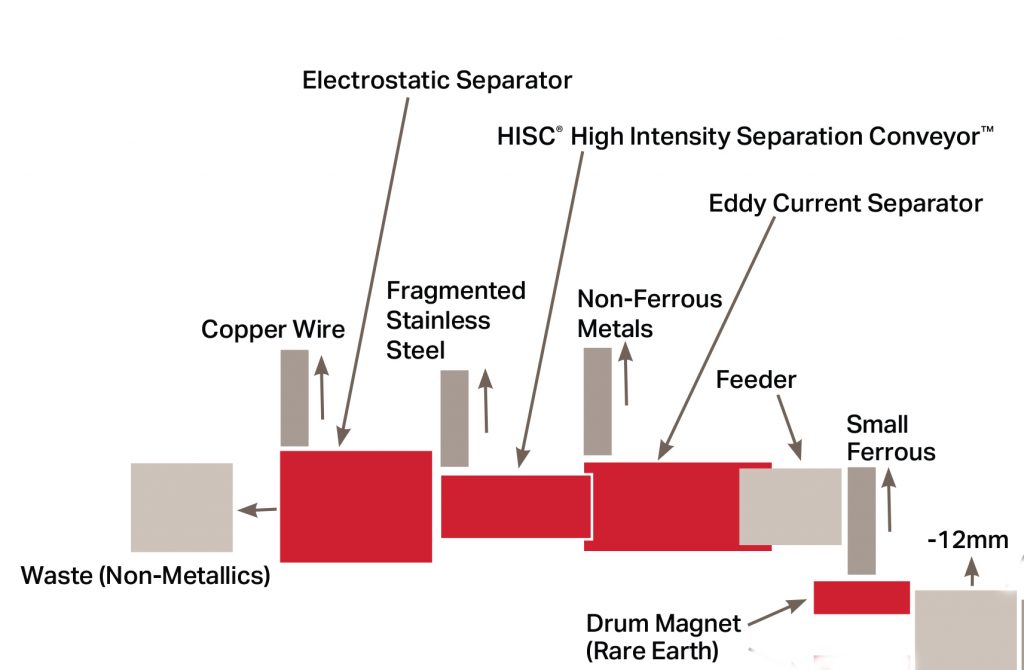
Efficiently recovering metal from the fraction below 12 mm is challenging and needs four stages of separation.
Ferrous metal
Permanent drum magnet
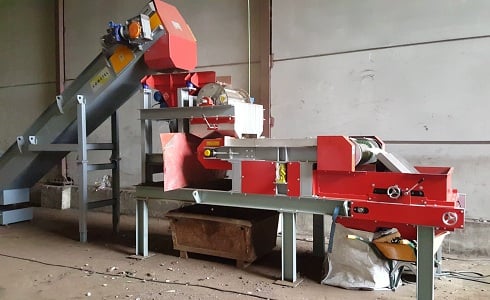
After screening, the fraction is fed by a vibratory feeder over a high-strength rare earth neodymium permanent drum magnet, usually with a radial field for maximum ferrous separation. The feeder gives close control of the feed, with a mono-layer falling a short distance onto the rotating stainless steel shell to avoid bounce. Magnetic particles attract to the radial poles and are carried underneath and out of the field into a separate collection area or conveyor. Non-magnetic and very weakly magnetic particles follow a normal trajectory to the next stage.
Non-ferrous metal
High-Intensity Eccentric (HIE) eddy current separator
The remaining mix, free of strongly magnetic material, feeds by another vibratory feeder onto the belt of an eddy current separator. Optimum separation and recovery of non-ferrous metal below 12 mm is achieved with the High-Intensity Eccentric (HIE) model.
Fragmented stainless steel
High-Intensity Separation Conveyor (HISC)
After the strong magnetics and larger non-ferrous metal are removed, the volume of material falls significantly. This mix is ideal for recovering fragmented stainless steel, which becomes weakly magnetic when it passes through a shredder. The HISC's ultra high-intensity neodymium head roll attracts and separates fragmented stainless steel and any other small magnetic material, leaving fine non-ferrous metal and non-metallic waste. See stainless steel separators.
Fine copper wire
Electrostatic separator
The final stage recovers fine copper wire and other metal below the operating range of eddy current separators (nominally below 2 mm). For optimum separation, the remaining material can be screened at around 3 mm to concentrate the fine copper, then processed on an electrostatic separator.
How do eddy current separators work?
An eddy current separator has a high-speed magnetic rotor mounted inside the slower-moving non-metallic head pulley of a short conveyor. The rotating, alternating-polarity rotor generates currents and opposing magnetic fields in non-ferrous metal particles, causing them to repel. Conducting metals such as aluminum and copper then follow a different trajectory from non-metallic material, and a carefully placed splitter separates the two. A vibratory feeder delivers a controlled mono-layer onto the belt, which carries it into the separation zone at the head pulley.
Eccentric
The magnetic rotor is mounted eccentrically, in one quadrant of the outer non-metallic shell.
Used here for: the fraction below 12 mm (HIE model).
Concentric
The magnetic rotor sits concentrically within the outer non-metallic shell.
Used here for: the 12 to 40 mm fraction (HIC model).
How does an electrostatic separator recover copper?
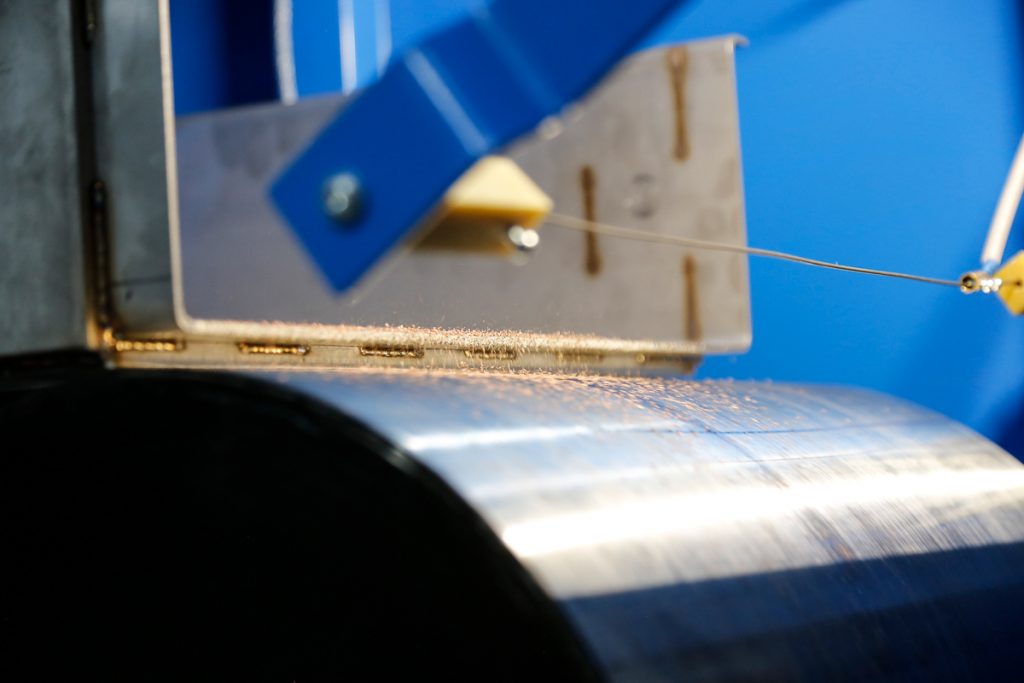
An electrostatic separator exploits differences in electrical conductivity between the materials in a feed. It induces an electrostatic charge in conductive, dry, liberated particles, which separates them from non-conductive material. Whether a separation is possible depends on key material characteristics:
- Conductivity
- Moisture content
- Particle size range
When processing shredded WEEE or cable below 12 mm, the electrostatic separator may be the only technology able to separate fine copper wire and other small non-ferrous metal. Depending on the composition of the feed, the copper wire fraction could be over 98% pure copper.
How is metal recovered from the 12 to 40 mm fraction?
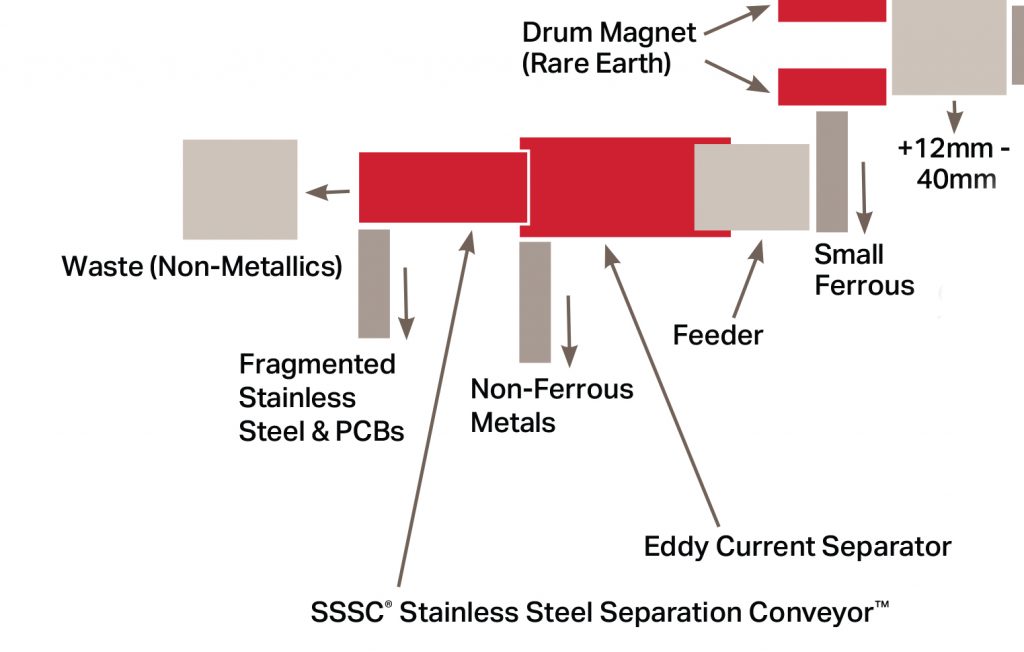
Metal recovery from the larger fraction is less demanding and needs three stages instead of four.
Ferrous metal
Permanent drum magnet
As on the line below 12 mm, the first stage recovers smaller ferrous metal with a high-intensity rare earth neodymium permanent drum magnet fed by a vibratory feeder. A radial magnetic field gives the highest degree of recovery.
Non-ferrous metal
High-Intensity Concentric (HIC) eddy current separator
For this fraction, the HIC eddy current separator gives optimum non-ferrous separation and recovery. A vibratory feeder provides a regulated mono-layer onto the feed belt, and non-ferrous metal is propelled away from the rotor into a separate collection area.
Stainless steel and PCBs
Stainless Steel Separation Conveyor (SSSC)
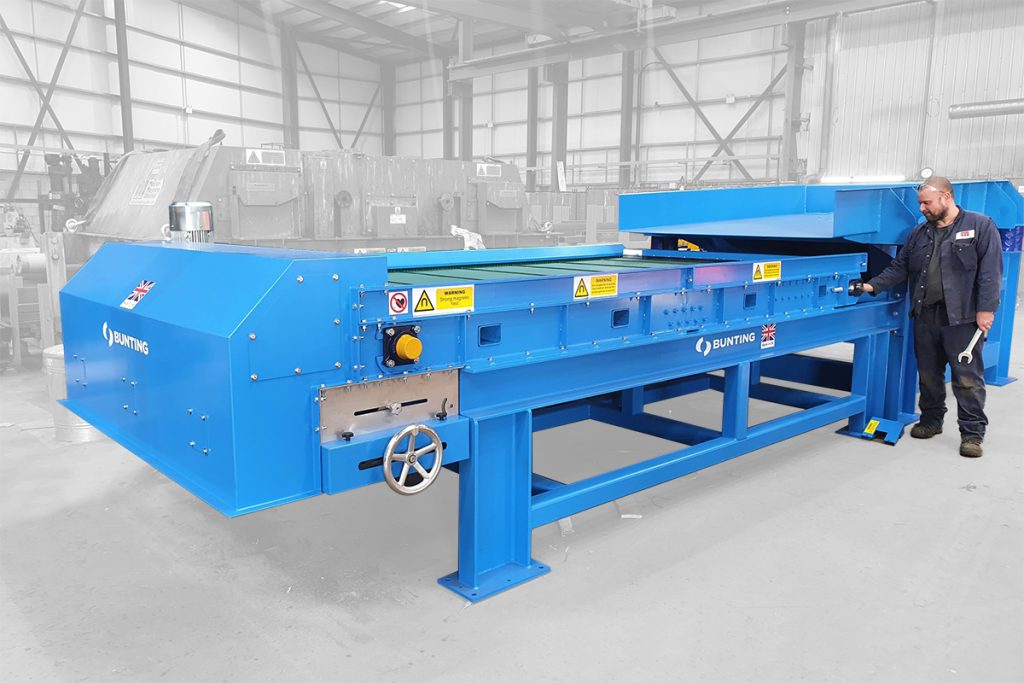
Unlike the HISC, the SSSC has a large-diameter ultra high-intensity neodymium magnetic roll to recover larger weakly magnetic particles. Experience on working installations shows the SSSC also recovers shredded green PCBs, which are then picked by hand or separated by reprocessing over the SSSC. See stainless steel separators.
What saleable fractions does the flowsheet produce?
Understanding the material and each processor's own process ultimately determines the right equipment. This typical flowsheet shows proven methods for producing seven saleable fractions:
| Fraction | Below 12 mm | 12 to 40 mm |
|---|---|---|
| Strong magnetics | Drum magnet | Drum magnet |
| Non-ferrous metal | HIE eddy current separator | HIC eddy current separator |
| Stainless steel and weak magnetics | HISC | SSSC |
| Fine non-ferrous metal such as copper wire (nominally below 2 mm) | Electrostatic separator | Not applicable |
Test before you specify. At Bunting's Customer Experience Centre in Redditch, UK, application engineers run controlled tests on laboratory-scale separators. The tests determine recovery rates and purity, and show whether the process needs changes such as more size reduction or better screening.
Related reading: ElectroStatic Separators for E-waste Recycling in Australia and Which Magnetic Separators Do Recycling Plants Use to Maximize Metal Recovery?
Frequently asked questions
How is metal recovered from WEEE?
WEEE is shredded to liberate the metal and screened into size fractions. Drum magnets then recover ferrous metal, eddy current separators recover non-ferrous metal, high-intensity magnetic separators recover fragmented stainless steel, and an electrostatic separator recovers fine copper wire.
How is fine copper wire recovered from shredded cable?
Copper wire below the operating range of eddy current separators, nominally below 2 mm, is concentrated by screening at around 3 mm and then separated on an electrostatic separator, which exploits the difference in electrical conductivity between copper and non-conductive material.
Can stainless steel be recovered from shredded WEEE?
Yes. Stainless steel becomes weakly magnetic when it passes through a shredder, so ultra high-intensity neodymium separators such as the HISC and SSSC can recover it after ferrous and non-ferrous metal have been removed.
What is the difference between eccentric and concentric eddy current separators?
In an eccentric separator the magnetic rotor sits in one quadrant of the outer shell; in a concentric separator it sits centrally. In this flowsheet the eccentric HIE model handles the fraction below 12 mm and the concentric HIC model handles the 12 to 40 mm fraction.