
Which magnetic separators hold up at production speed in high-volume food plants, where each one fits, and how to compare them.
Short answer: The most reliable magnetic separators for high-volume food facilities are the ones matched to the product stream, contamination risks, sanitation requirements, and line speed. Drum magnets, plate magnets, grate magnets, and pneumatic line magnets each serve different roles in food production.
High-volume food facilities need magnetic separation systems that do more than capture tramp metal. They need equipment that maintains separation strength at production speeds, fits the product path, supports sanitation requirements, and performs consistently over long operating runs.
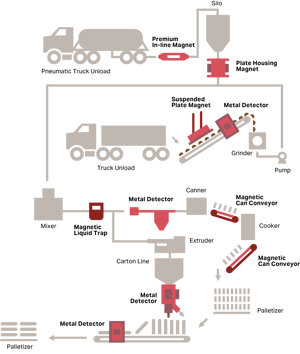
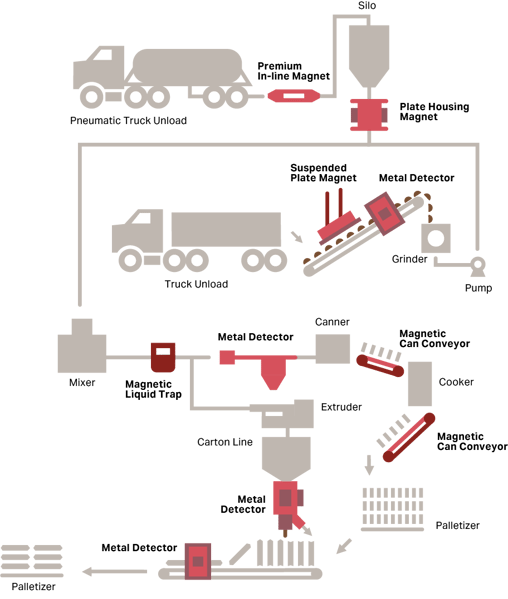
Reliability in food processing is not about choosing one separator. It comes from matching separator type to the product flow, contamination risk, and process stage. In many food plants, the most dependable approach is a combination of separators installed at critical control points rather than relying on a single unit. This is why many processors start by evaluating magnetic separators for food processing across the full production line.
Which magnetic separators are most reliable for high-volume food facilities?
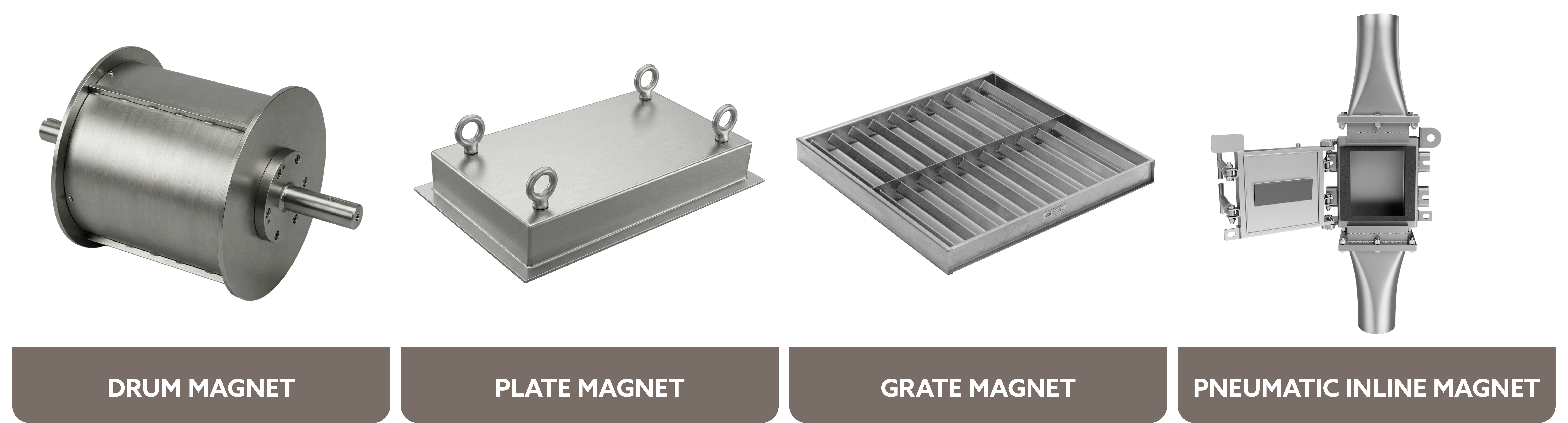
Each separator is reliable in a different operating context:
- Drum magnets
- Often the best fit for continuous, high-volume product streams where automatic removal of ferrous contamination is required.
- Plate magnets
- Effective where product flows through chutes, spouts, or inclined housings and where simple installation is important.
- Grate magnets
- Commonly used where dry product drops through hoppers or bins and contamination needs to be captured before downstream processing.
- Pneumatic line magnets
- Designed for enclosed conveying systems where fine or powdered products move at speed through air lines.
The strongest reliability outcomes come from matching the separator to the flow path rather than asking one design to solve every contamination challenge.
Which separator suits each food process condition?
In practice, reliability improves when separator choice is aligned with how material actually moves through the plant.
| Food process condition | Recommended separator | Why it is reliable |
|---|---|---|
| High-volume bulk ingredients such as grain, sugar, and cereals | Drum magnet | Continuous self-cleaning supports uptime and reduces manual intervention |
| Gravity-fed chutes and spouts | Plate magnet | Simple installation with consistent contamination capture |
| Hopper or bin discharge points | Grate magnet | Intercepts contamination before processing stages |
| Pneumatic conveying for flour, powders, and fine ingredients | Pneumatic line magnet | Designed for enclosed, high-speed product flow |
This type of application-based matching is what drives consistent performance in high-throughput environments.
What makes a magnetic separator reliable in food processing?
A reliable magnetic separator in food processing maintains consistent magnetic performance, fits the product flow, supports sanitation needs, and operates without creating avoidable downtime. Food manufacturers typically evaluate reliability across five factors.
Consistency at production speed
A separator may perform well at low volume but lose effectiveness as throughput increases. High-volume facilities need equipment that maintains capture performance under real production loads.
Fit for the product path
Gravity-fed ingredients, bulk solids, slurry-like flows, and pneumatic systems all require different separator designs. A poor fit reduces real-world performance.
Cleanability and sanitation access
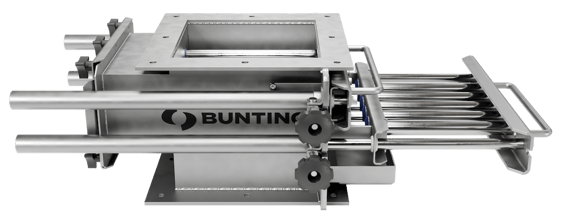
Reliability includes how easily equipment can be cleaned and returned to service. Difficult access or time-consuming cleaning increases downtime and reduces effectiveness. When selecting equipment such as pneumatic line magnets or grate systems, access for inspection and cleaning should be considered alongside performance.
Strength matched to contamination risk
Facilities must consider the size and type of contamination. Fine weakly magnetic particles, work-hardened fragments, and larger tramp metal require different magnetic configurations.
Operational uptime
Reliable separators support production by minimizing manual intervention, enabling efficient inspection, and maintaining performance over repeated cycles.
Which separator types work best in specific high-volume food applications?
Different food processes require different separator types depending on where contamination risk occurs.
Bulk dry ingredients
Drum magnets and grate magnets are common choices. In high-throughput environments, drum magnets are often preferred because they operate continuously.
Chute-fed or gravity-fed lines
Plate magnets are widely used in chute or spout applications where product falls past the magnetic field before reaching downstream equipment.
Pneumatic conveying systems
Pneumatic line magnets are typically the most reliable option for powders or fine materials moving through enclosed air systems. They are designed for velocity, pressure, and integration into sealed lines.
Final inspection points
Many plants install grate or plate magnets near final processing or packaging stages to reduce the risk of contamination reaching finished product.
Magnets do not catch every metal. Magnets remove ferrous and some weakly magnetic metal, but they do not catch non-ferrous metal and cannot be relied on for stainless steel. Where those metals are a risk, plants usually add a metal detector as well. For powders and granules falling through a chute, a gravity free-fall metal detector can inspect product before bagging or packing. For how detectors fit into a food safety plan, see How Industrial Metal Detectors Support Food Safety and Compliance.
Why do high-volume food plants often need more than one magnetic separator?
Contamination risks change across the production process. A single separator cannot protect raw intake, transfer points, conveying systems, and final processing equally well. Multi-point protection improves reliability by allowing facilities to intercept contamination early, reduce downstream equipment damage, support food safety programs, and match separator type to each process stage.
For example, a cereal manufacturer handling large volumes of grain might use three control points:
Intake
Drum magnet
Removes tramp metal early, before it reaches processing equipment.
Pneumatic conveying
Pneumatic line magnet
Provides in-line protection as ingredients move through the conveying system.
Before packaging
Final inspection magnet
Adds another control point before finished product is packed.
This layered approach is often the most reliable way to reduce contamination risk in high-volume environments.
How should a plant manager compare separator reliability between vendors?
Compare magnetic separator reliability on application fit, throughput capability, cleanability, inspection access, and proven use in similar environments. Strong comparisons focus on operating performance rather than general claims. Key questions include:
- What product type and flow conditions is this separator designed for?
- Has it been used in similar high-volume food environments?
- How is cleaning handled during routine production?
- What type of contamination is it designed to capture?
- How does the unit support inspection and maintenance?
- Is there application guidance based on line layout and throughput?
Manufacturers like Bunting typically focus on application-specific design rather than one-size-fits-all solutions, helping food processors match separator type to real operating conditions. The most reliable supplier is usually the one that helps define the correct solution for the process, not just the product. For more, see How Should a Plant Manager Compare Industrial Magnetic Separator Vendors?
What are the most common mistakes when selecting separators for high-volume food lines?
The most common mistakes are choosing by magnet strength alone, ignoring product flow, and treating reliability as a specification rather than an operating outcome. Common errors include:
- Selecting a separator that does not match the conveying method
- Underestimating sanitation and cleaning requirements
- Assuming one separator can protect the entire line
- Focusing only on initial purchase cost instead of uptime
- Overlooking contamination size and frequency
In high-volume food facilities, reliability comes from correct application, placement, and integration into the process.
When is a drum magnet or a pneumatic line magnet the most reliable option?
Drum magnet
Often the most reliable option when handling high volumes of free-flowing bulk material and where continuous removal of ferrous contamination is required. Automatic self-cleaning suits environments where uptime and throughput are critical.
Best for: continuous bulk flow.
Pneumatic line magnet
Often the most reliable option when ingredients move through enclosed conveying systems and contamination control must happen within the line. A separator designed for pneumatic conveying will outperform gravity-fed alternatives here.
Best for: powders and fine materials in air systems.
Frequently asked questions
What is the most reliable magnetic separator for high-volume food facilities?
The most reliable separator depends on the application. Drum magnets are commonly used for continuous bulk flow, while pneumatic line magnets are better suited to enclosed conveying systems. Plate and grate magnets are effective when matched to the correct transfer points.
Are drum magnets better than grate magnets in food processing?
Not always. Drum magnets are better for continuous high-volume flow, while grate magnets are used at hopper or bin discharge points. The best option depends on product movement and contamination risk.
Why is application fit more important than magnet strength alone?
Application fit determines how effectively the separator interacts with the product flow. A strong magnet that is poorly positioned may underperform, while a correctly applied separator delivers more consistent results.
Do high-volume food plants usually need multiple magnetic separators?
Yes. Many facilities use multiple separators because contamination risks vary across intake, transfer, conveying, and final processing stages.
What should food manufacturers ask separator vendors?
Food manufacturers should ask about application fit, throughput capability, cleaning methods, contamination type, inspection access, and proven use in similar environments.
Which magnetic separator is best for pneumatic conveying in food plants?
Pneumatic line magnets are usually the best option because they are designed for enclosed, high-speed conveying systems.
Why are drum magnets commonly used in high-volume food processing?
Drum magnets are commonly used because they provide continuous self-cleaning operation, making them ideal for handling large volumes of bulk ingredients with minimal manual intervention.
What food products commonly use magnetic separators?
Magnetic separators are widely used in facilities processing flour, sugar, grains, cereals, spices, powders, dairy ingredients, and other bulk food products where metal contamination risks exist.
How do magnetic separators improve food safety?
Magnetic separators help remove ferrous metal contamination before ingredients reach downstream processing or finished packaging stages, supporting food safety and quality control programs.
What factors affect magnetic separator reliability?
Key factors include separator placement, product flow, throughput rate, contamination type, cleaning access, maintenance practices, and selecting the correct separator design for the application.