

Updated October 2026. Revised for Bunting's current magnetic separation and metal detection range, with a new spice plant flowsheet.
Where metal gets into a spice process, and where magnets and metal detectors belong from delivery to the final pack.
Short answer: Metal can enter spices during growing and harvesting, and again inside the plant, especially at grinding, screening, and mixing. Most spice plants use magnetic separators to remove ferrous metal early and protect the grinder, and metal detectors to check for ferrous, non-ferrous, and stainless steel contamination before storage and packing.
Spices are grown mainly in hot, tropical regions, with some seed spices, such as coriander, grown in cooler climates. Wherever they come from, raw spices can arrive carrying stray metal, and processing adds more as equipment wears. No single separator or detector covers every risk, so spice plants place them at several points in the line. This guide walks through a typical spice plant from delivery to the final pack.
Where does metal get into spices?
Metal contamination in spices usually comes from three places:
- Growing and harvesting, before the spices reach the plant
- Grinding and screening, where wear on grinders, sifters, and screens can release fine metal
- Mixing and handling, where wear on mixers and conveying equipment adds more
Grinding and mixing are the stages where contamination is most likely inside the plant, so they are where separators and detectors matter most.
Where do magnets and metal detectors go in a spice plant?
The layout below is a typical spice plant. Your line may need more or fewer control points depending on your raw materials, process, and customer requirements.
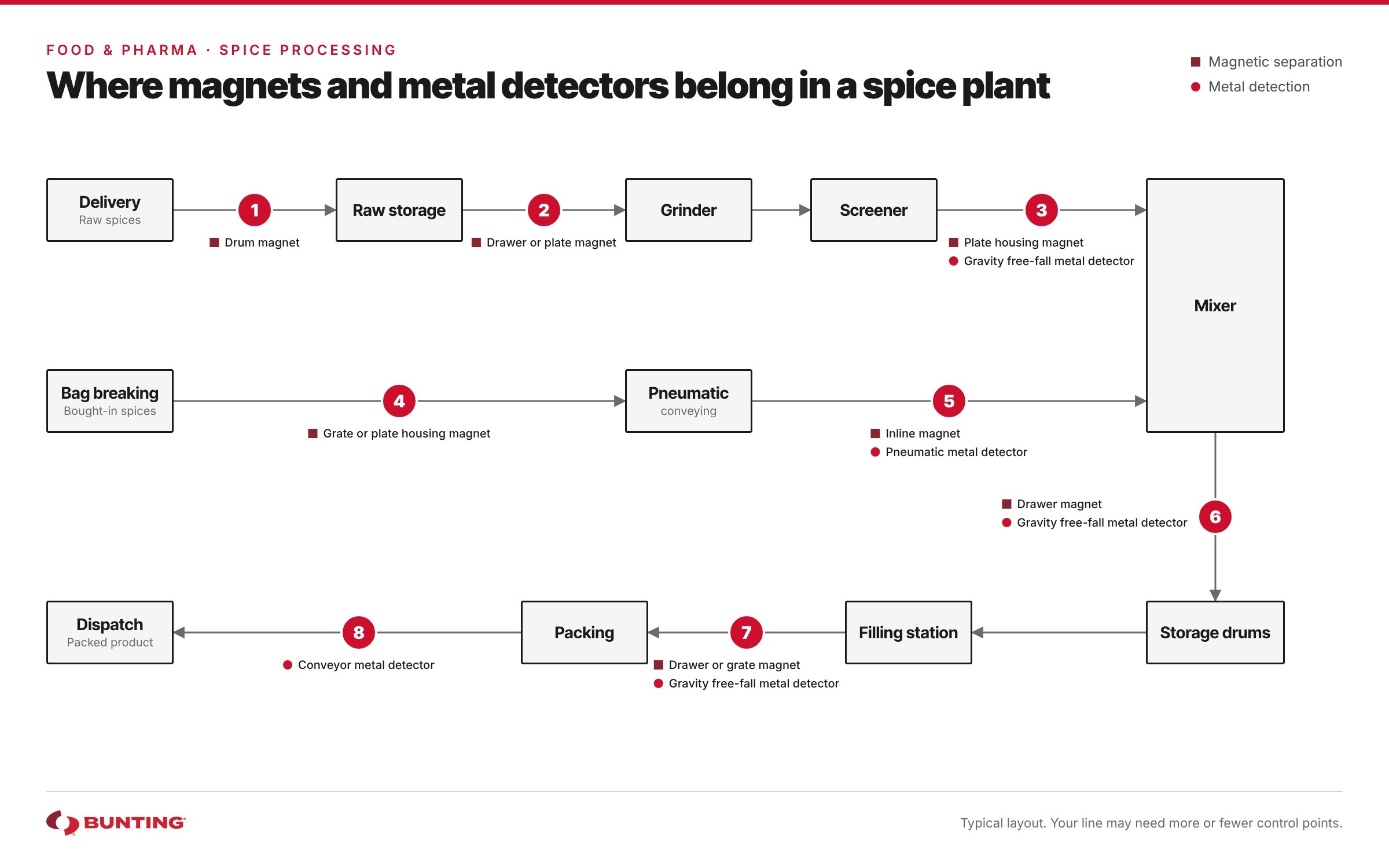
On delivery
Drum magnet
Removing metal before it enters the process is the best option, because contamination is larger and easier to separate at this stage. Delivered spices pass over a drum magnet, with ceramic ferrite or high-intensity rare earth magnets, before going into storage.
Before grinding
High-intensity magnet
The grinder is vulnerable to metal damage, which is costly and stops production. A high-intensity rare earth magnet in the feed, such as a drawer magnet or a plate magnet in the chute, captures ferrous metal that passed the drum magnet.
Protects: the grinder.
After grinding and screening
Magnet and gravity free-fall metal detector
Grinding releases metal trapped in the spice, and wear on the grinder and screens adds fine ferrous particles. Screened spice passes through a plate housing magnet, which has a wide, open throat so it does not restrict flow, followed by a gravity free-fall metal detector that rejects ferrous, non-ferrous, and stainless steel contamination.
Bag breaking
Magnet in the hopper
Bought-in spices for blends, such as sauce or seasoning mixes, often arrive in bags, and bag breaking is a high-risk point for contamination. A grate magnet with rare earth tubes in the hopper captures fine and larger ferrous metal. Where spices have a wider particle size range or are not fully dry, a plate housing magnet with an unrestricted throat is a better fit.
Pneumatic feed to the mixer
Inline magnet and pneumatic metal detector
Where spices are conveyed pneumatically to the mixer, an inline magnet removes ferrous contamination, followed by a pneumatic metal detector that detects and rejects ferrous, non-ferrous, and stainless steel metal before the mixer.
After mixing, before storage
Drawer magnet and gravity free-fall metal detector
Wear in the mixer and the rest of the plant can add metal to the blend. Blended spice is gravity-fed through a drawer magnet with rare earth tubes and a gravity free-fall metal detector before going into storage drums.
At the filling station
Drawer magnet and gravity free-fall metal detector
Before packing, a drawer magnet or a grate magnet in the hopper removes fine ferrous metal, and a gravity free-fall metal detector rejects any remaining metal.
Final pack check
Conveyor metal detector
Many buyers, particularly large retailers, require packed product to pass through a conveyor metal detector before dispatch.
Why does a spice plant need so many control points?
Several stages of magnets and detectors can look excessive, but metal enters at many points in a spice process, especially after grinding and mixing. Placing separators and detectors at those points protects both the finished product and the equipment downstream, and finds a problem close to where it starts.
Magnets and detectors do different jobs. Magnets remove ferrous metal and protect equipment while product keeps flowing. Metal detectors inspect for ferrous, non-ferrous, and stainless steel contamination, depending on fragment size and the product. For more on how detectors fit into a food safety plan, see How Industrial Metal Detectors Support Food Safety and Compliance.
The right combination depends on your spices, particle size, moisture, flow method, and customer requirements. Testing with your own material shows what each separator and detector can achieve before you specify.
Frequently asked questions
Where does metal contamination in spices come from?
Metal can enter spices during growing and harvesting, and inside the plant from wear on grinders, screens, mixers, and conveying equipment. Grinding and mixing are the most likely points of contamination during processing.
Where should a magnet go in a spice plant?
Magnets are typically installed on delivery, before the grinder to protect it, after grinding and screening, at bag breaking, in pneumatic lines, after mixing, and at the filling station.
Do spice plants need metal detectors as well as magnets?
Usually, yes. Magnets remove ferrous metal, while metal detectors inspect for ferrous, non-ferrous, and stainless steel contamination. Many buyers also require a final check on packed product with a conveyor metal detector.