

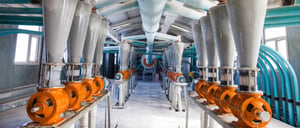
Where magnetic separators and metal detectors belong in a flour mill, from the intake pit to the packing line, and what each one protects.
Grain arrives at the mill carrying metal. Some of it comes from the field: wire, bolts, and fragments from harvesting equipment. Some comes from the trucks, railcars, and augers that moved it. More is added inside the plant as elevators, conveyors, screens, and rolls wear.
Because metal enters at several points, it has to be removed at several points. One magnet at intake does not protect a roller mill three floors up, and it does nothing about a stainless steel fragment from a broken sifter screen.
This guide follows a typical wheat mill stage by stage and shows where each type of equipment goes, what it catches, and what it protects. Every mill is laid out differently, so use it as a starting map for your own line.
Two ways to remove metal
Magnetic separators and metal detectors do different jobs. Most mills need both.
Magnetic separators
Capture ferrous metal and hold it until the magnet is cleaned. No reject gate, no lost product. Rare earth designs also pull fine iron particles out of flour and bran.
Catches: iron and steel, nails, bolts, wire, rust scale, fine iron.
Metal detectors
Sense metal in the product stream and trigger a reject that diverts a small amount of product out of the line. They find what a magnet cannot hold.
Catches: ferrous, non-ferrous such as aluminum, brass, and copper, and stainless steel.
The usual pattern is magnets early and often, to protect equipment as grain moves through the mill, and metal detectors near the end, as the final inspection before product ships.
The mill, stage by stage
Six points in a wheat mill where metal is most likely to enter or do damage.
-
Truck and railcar receiving
Grain intake
This is the highest risk point in the mill and where the largest tramp metal turns up. Anything that came from the field or the transport arrives here in one load.
- Grate Magnet
- Sits in the intake pit or hopper and catches large tramp iron as grain is dumped.
- Plate Magnet
- Mounted on the intake conveyor or spout ahead of the elevator to catch smaller pieces.
- Magnetic Head Pulley
- Replaces the head pulley on the intake belt and removes ferrous metal continuously as grain discharges.
Protects: the receiving elevator, conveyors, and every stage downstream.
-
Between the blending bins and the mill mix bins
After blending
Grain from different lots is blended to hit a target protein and moisture. Moving it through the bins frees metal that was buried in the grain on the first pass.
- Plate Magnet
- A second plate magnet on the discharge from the blending bins.
- Hump Magnet
- Two plate magnets offset in a dogleg housing. Grain falls onto the first magnet, tumbles, and falls onto the second, which exposes metal the first magnet could not reach.
Protects: the cleaning equipment in the next stage.
-
Screens, aspirator, and destoner
Cleaning
Before milling, wheat is cleaned. Screens remove oversize and undersize material, the aspirator pulls off dust, chaff, and light impurities, and the destoner removes stones and other heavy debris. The clean wheat is then dampened and held in tempering bins so the bran toughens and separates cleanly in the mill.
- Center Flow Magnet
- An inline gravity magnet ahead of the cleaning equipment. The magnetic element sits in the center of the flow and holds captured metal until the magnet is cleaned.
- Plate Magnet after the destoner
- A safety net for the cleaning equipment itself. If a screen tears or a machine sheds a part, this magnet catches the fragments before the wheat goes to tempering.
Protects: the tempering system and the mill.
-
Feed to the first break rolls
Before the roller mills
After tempering, wheat enters the most expensive equipment in the plant: roller mills, sifters, and purifiers. A piece of tramp metal here can chip or score a roll, tear sifter screens, and stop the line until repairs are made.
- Rare earth Center Flow Magnet
- One on each feed to the first break rolls, with a neodymium rare earth element to capture the small ferrous pieces that got past earlier magnets.
Protects: roller mills, sifters, and purifiers.
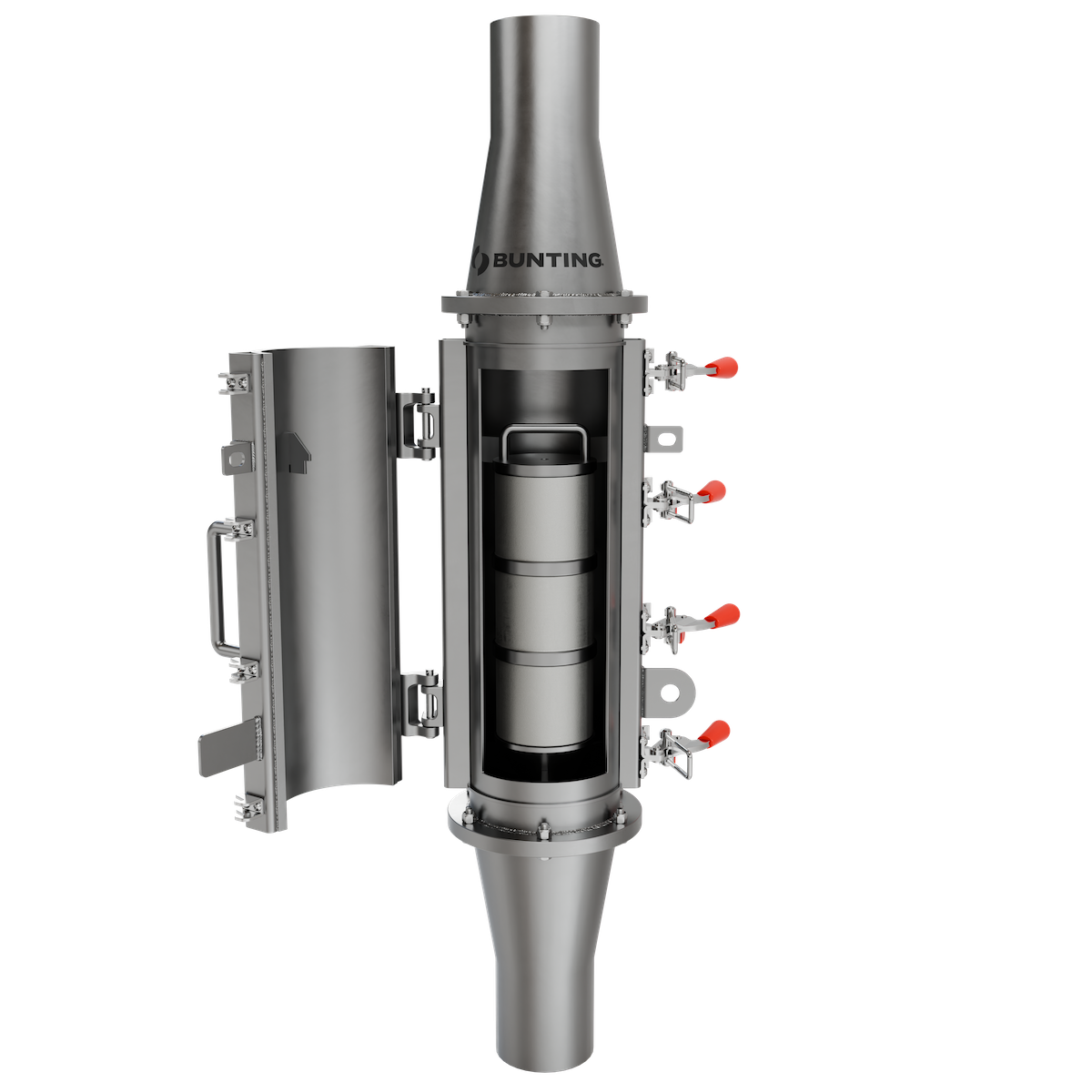
Center flow magnet with the access door open to the magnetic element. -
After the sifting system
Bran and flour streams
Milling splits the wheat into two main streams: flour, or semolina when milling durum, and bran. Each needs its own protection, because metal worn off the rolls and sifters travels with both.
- Rare earth Plate Magnet, bran stream
- Ahead of the hammer mill or bran finisher. Protects it from damage and reduces wear before the bran goes to storage for shipment.
- HF Drawer Magnet, flour stream
- After the reduction rolls and before bleaching or treatment, where used. A high-intensity drawer magnet for fine iron in dry, gravity-fed flour.
- Center Flow Magnet or Pneumatic In-Line Magnet
- After treatment and ahead of flour storage. Use a center flow magnet on gravity lines and a pneumatic in-line magnet on pneumatic lines.
Protects: the hammer mill, flour storage, and finished product.
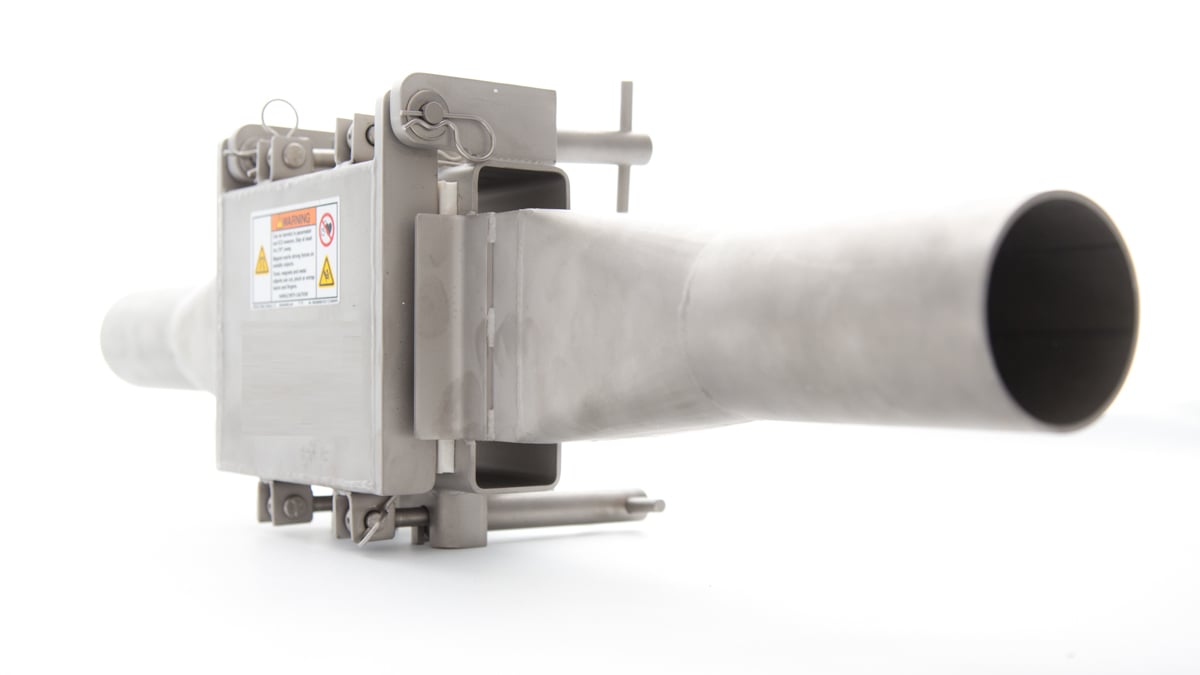
Pneumatic In-Line Magnet for pneumatically conveyed flour. -
Bulk load-out and bagging
Before product leaves the mill
This is the last chance to catch metal, and the point where metal detection matters most, because it is the only way to find non-ferrous and stainless steel contamination.
- Bulk load-out
- Just before loading trucks or railcars, flour passes through a Center Flow Magnet, an HF Drawer Magnet, or a Performer Elite Food P pneumatic metal detector, depending on how the line conveys product.
- Performer Elite GF gravity-fall metal detector
- Ahead of the packer. Inspects flour as it falls and rejects metal before it reaches a bag, so less finished product is rejected later.
- Conveyor metal detector for packed product
- Every finished bag passes through a detector on the packing line. Many end customers require this check before they accept product.
Protects: your customers and your shipments.
The full layout at a glance
| Stage | Equipment | What it catches | What it protects |
|---|---|---|---|
| 1. Intake | Grate Magnet, Plate Magnet or Magnetic Head Pulley | Large tramp iron, bolts, wire | Elevators, conveyors |
| 2. After blending | Plate Magnet or Hump Magnet | Ferrous metal freed during blending | Cleaning equipment |
| 3. Cleaning | Center Flow Magnet, Plate Magnet after destoner | Ferrous metal, broken screen and machine parts | Tempering, mill |
| 4. First break | Rare earth Center Flow Magnet | Small ferrous pieces | Roller mills, sifters, purifiers |
| 5. Bran | Rare earth Plate Magnet | Ferrous wear metal | Hammer mill, bran finisher |
| 5. Flour | HF Drawer Magnet, Center Flow Magnet or Pneumatic In-Line Magnet | Fine iron | Storage, finished product |
| 6. Load-out | Magnet or Performer Elite Food P | Ferrous; detector adds non-ferrous and stainless | Bulk shipments |
| 6. Packing | Performer Elite GF, conveyor metal detector | Ferrous, non-ferrous, stainless steel | Packed product |
Why so many points?
Ten or more separation and detection points can look like overkill. Each one is there for a reason: to protect a specific machine, or to catch metal introduced by the stage before it. Take one out and the risk moves downstream, usually to more expensive equipment or into finished product.
Placement is half the job. Upkeep is the other half. A magnet loaded with captured metal loses holding capacity, and metal can wash off into the product, so set a cleaning schedule for every magnet. Check detectors on a regular schedule with certified test pieces. No combination of equipment makes a line metal-free on its own. The right equipment in the right place, maintained, keeps the risk low.