


Why fine iron is so hard to pull out of dry powders, and which magnetic separators and metal detectors deal with it.
Short answer: fine iron hides inside clumps of powder, out of reach of the magnetic field, so even the strongest magnetic separator can miss it. Remove large tramp metal before size reduction turns it into fine iron, then use high-strength rare earth separators chosen around the way the powder flows.
Effectively separating fine iron from dry powders is often challenging. Even the strongest magnetic separator may fail to successfully remove the magnetic particles. In order to find a successful solution, it is important to understand the way fine materials behave. Only then is it possible to determine the optimum method to cleanse a powder of problematic fine iron.
What makes a powder hard to handle?
Dry powders are used in a wide variety of industries including food, pharmaceuticals, refractories, and chemicals. It is estimated that 80% of materials used in industry are in a dry powdered form.
A powder is defined as fine dry particles produced by the grinding, crushing, or disintegration of a solid substance. The handling and processing of powders is often challenging as bulk powders exhibit similar properties to both solids and liquids.
Where does the iron in a powder come from?
The introduction of metal contamination, commonly in the form of iron, occurs at any stage within a powder process. If larger tramp metal (for example nails, nuts or rust) remains undetected it enters the size reduction stage. Such tramp metal often damages process equipment, with magnetic separators and metal detectors installed to capture and remove the metal. If it passes through this stage, the tramp metal becomes significantly reduced in size and, subsequently, increasingly difficult to extract.
Metal contamination in bulk powders commonly originates from:
- Primary large tramp metal, such as a nail, screw or bolt.
- Primary fine iron or magnetic particles that are present in the raw material. This originates from primary processing, transportation, or even occurs naturally in the original material.
- Secondary fine iron from a larger item of tramp metal that has been reduced in size during the powder manufacturing process. Typically, this could be from a nail, screw or bolt that has been through a crusher, or from damaged or worn processing equipment. Another common source is rust falling into the process from weathered and worn equipment such as chains, hoists, and building cladding.
Magnetically susceptible metal contamination (iron) is commonly removed using magnetic separators. Although there are magnetic separators where the magnetic field is produced with an electrical current, the vast majority use permanent magnets such as Ceramic Ferrite and Rare Earth Neodymium Iron Boron (Neodymium). Ceramic Ferrite magnets produce low strength but deep magnetic fields, while Neodymium magnets create the strongest permanent magnetic fields presently commercially available.
Why remove large tramp metal first?
The separation and detection of tramp metal is easier when the contamination is in a larger form, and it can be removed using a wide range of magnetic separators and metal detectors. Magnetic separators using standard strength Ceramic magnets, with deep magnetic fields, are ideal. A good example is the Plate Magnet, often installed in a chute, in a housing, or as part of an In-Line Magnetic Separator.
Larger metal contamination is also easier to detect on a metal detector. Metal is detected as it passes through the coil of the metal detector, and an automatic reject system removes it from the flow. For detection, the magnetic field generated by the metal detector has to see a state change. Finer metal produces a smaller state change and is therefore harder to detect.
In a project in Pakistan, a processor of fine sodium bicarbonate is using a Performer Elite GF gravity-fall metal detector to remove the larger tramp metal.
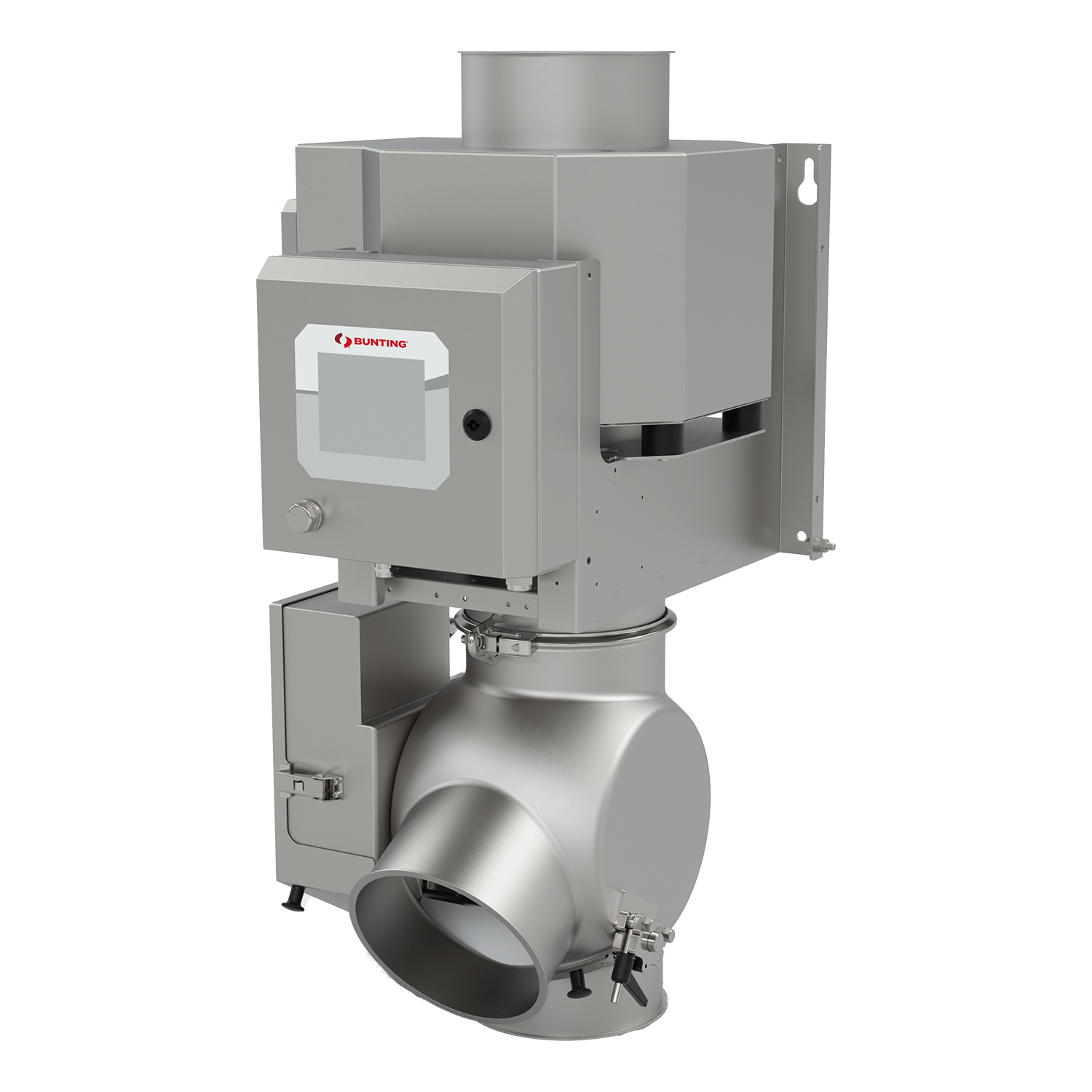
Catch it before the mill. Removing larger tramp metal with a magnetic separator and metal detector before the processing stage prevents the metal being reduced in size and becoming a secondary source of fine iron. It also protects delicate processing equipment such as crushers, shredders, and mills from damage.
Once the material is in powder form, there are important processing parameters to consider when assessing the optimum method to remove fine iron contamination.
Why does fine iron escape a magnetic separator?
When a powder is sprinkled, it remains light and free. However, when the same powder is vibrated or compressed, it may become very dense and even lose the ability to flow.
Individual grains in bulk powders cling to each other in clumps, in accordance with the Van der Waals force. This coagulation often traps fine iron among clean product. The ability of any magnetic separator to attract, hold and separate fine iron depends on the iron being as close to the magnetic field as is physically possible. If the fine iron contacts the surface of a magnetic separator with a high strength magnetic field, it will be held. When the fine iron is held inside a clump of powder, it can be kept out of reach of the maximum magnetic force, and it will not be separated.
The way bulk powders flow also shapes the design of the magnetic separator. Powders flowing in a hopper may experience classic flow problems such as ratholing, bridging or flooding, all of which can be made worse by the design of the magnetic separator.
Which magnetic separators work on powders?
High strength magnetic fields, as produced by Rare Earth Neodymium magnets, are needed to capture fine iron contamination. These are the main magnetic separator designs suitable for handling powders.
| Design | How it works | Where it fits |
|---|---|---|
| Drawer filter and grate magnets | Rows of tube magnets that powder falls through | Inside a hopper, or in its own housing |
| Plate magnets | Flat magnetic face the material flows over | Chutes and in-line housings |
| In-line magnets | Plate magnets built into spouting or conveying line | Gravity spouting up to 60 degrees from horizontal, or dilute phase pneumatic lines up to 15 psi |
| Drum magnets | Stationary magnetic arc inside a rotating shell | Vibratory-fed materials with a high specific gravity, such as abrasives and refractories |
| Electromagnetic dry filter | Electromagnetic coil around a vibrating canister packed with magnetic stainless steel matrix | High-value fine powders processed in controlled batches |
Drawer filter, grate and tube magnets
Although a tube magnet (also known as a rod or cartridge magnet) may occasionally be used on its own, it is more commonly part of a larger multi-cartridge grate system. The magnetic grate is designed to fit inside a hopper, or can be supplied complete with a housing as a Drawer Filter Magnet.
In operation, powder falls freely onto the surface of the tube magnets, where fine iron strikes the surface and is held by the strong magnetic field. To make sure the powder contacts the tube surface, deflectors are often fitted above the gaps between the tubes.
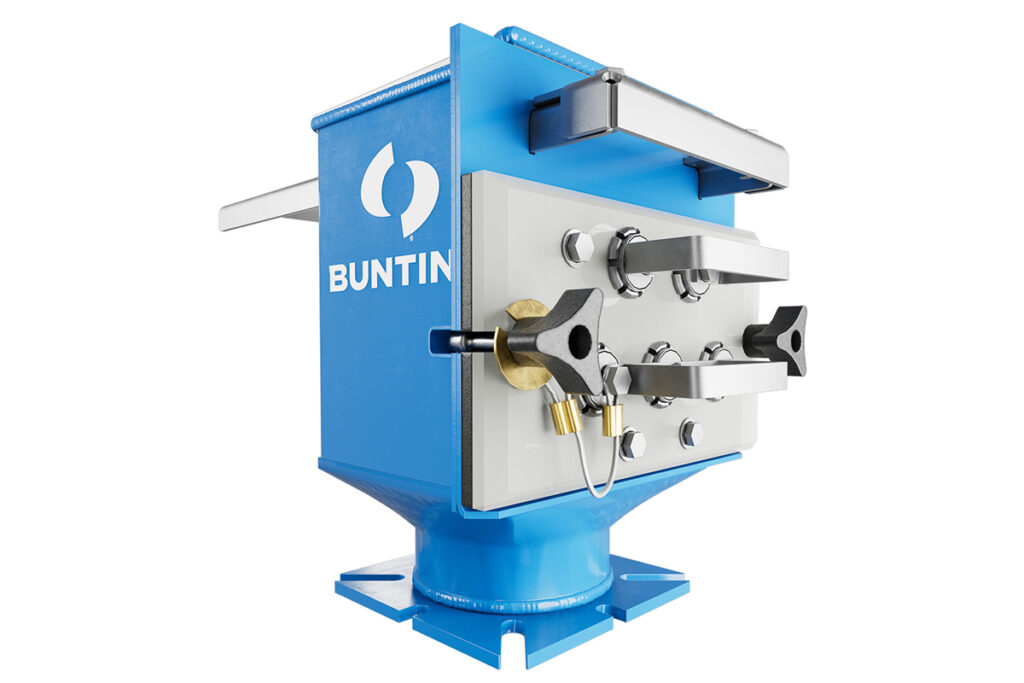
Powder build-up on the surface of a tube magnet reduces separation efficiency. In severe cases, a slight build-up on the tubes can quickly block the whole housing.
Blockages can be prevented by ensuring there is optimum space between the tube magnets. In some cases, mounting an external vibrating motor on the side of the hopper or housing provides enough disturbance to prevent material coagulation. The frequency of the vibration needs careful consideration as it can affect the flowability of the powder. When vibrators are used, the tube magnets need to be built to withstand prolonged vibration.
Teardrop shaped tube magnets are specifically designed to stop fine powder building up on the surface. The sharp edge of the teardrop faces up into the product flow and lets material flow around the edge and into the magnetic field. Magnetic particles are captured and held underneath the tube.
Plate magnets
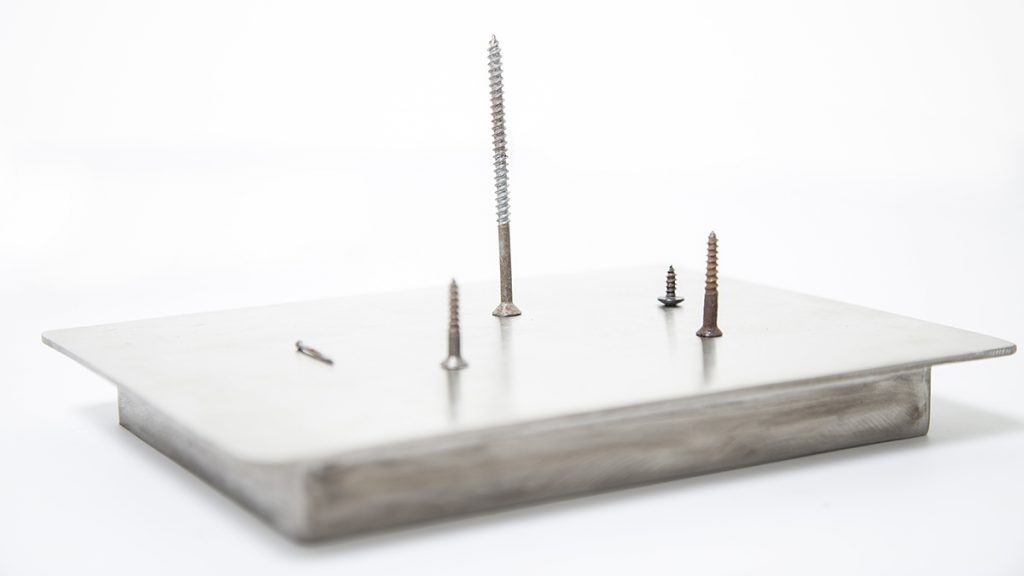
Flat-faced plate magnets are ideal when the material can flow over the surface. Rare Earth Neodymium plate magnets capture finer iron. The magnetic field is further enhanced when a tapered step is added to the face of the magnet. Captured iron migrates behind the step and away from the material flow, reducing the risk of it re-entering the cleansed product.
In-line magnets
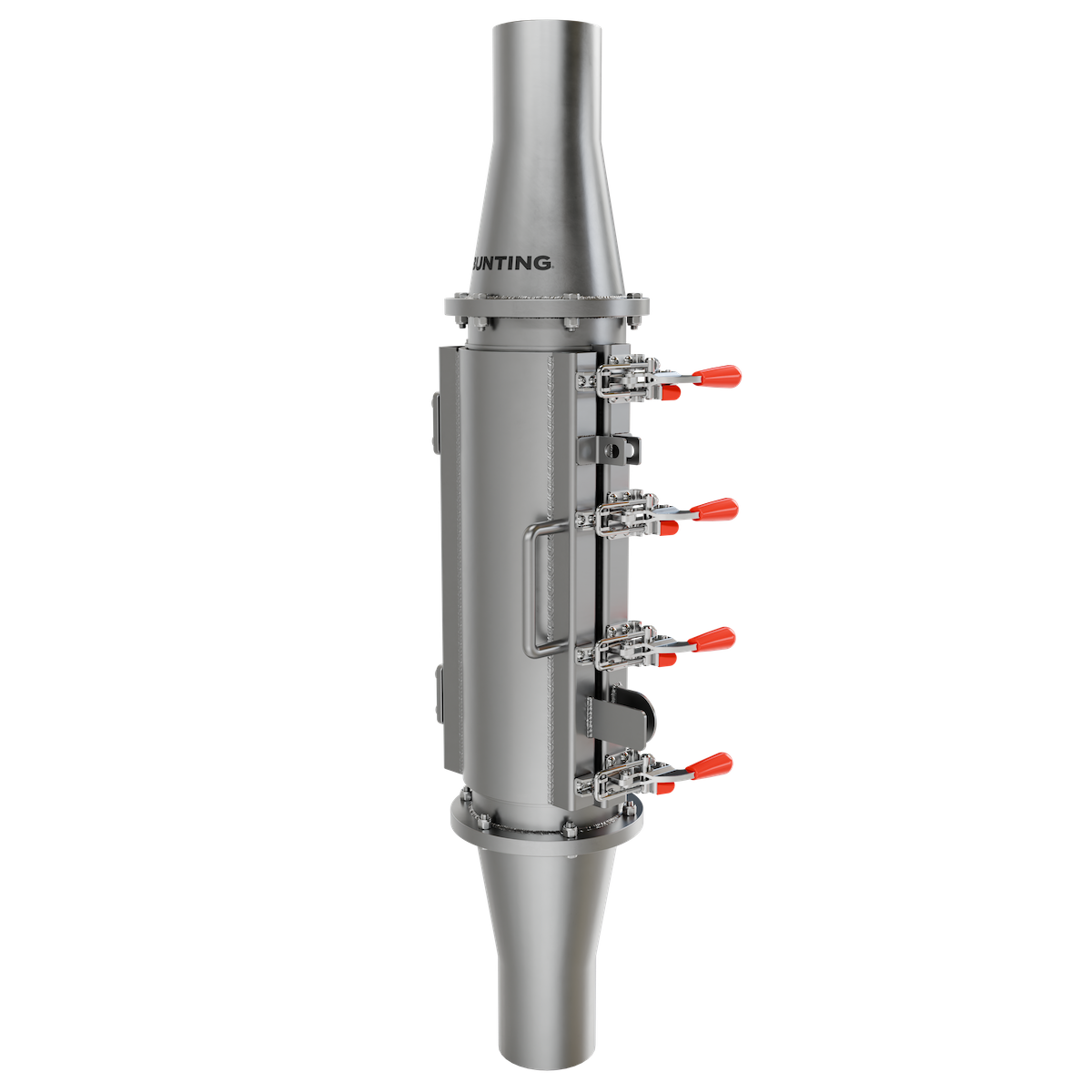
As well as being fitted into chutes, plate magnets are built into housings as In-Line Magnets. In-line magnets remove tramp iron and ferrous fines from flow-resistant bulk powders without restricting the flow. There are two designs.
Gravity In-Line Magnets (GIM)
The plate magnets sit in round, sloping spouting where material is under gravity flow.
Key condition: for effective tramp metal capture, the spouting should be angled no more than 60 degrees from horizontal.
Pneumatic In-Line Magnets (PIM)
For dilute phase pneumatic conveying systems up to 15 psi. They install easily with optional factory-supplied compression couplings.
Key condition: they work best in horizontal runs with the plate magnet down, to take advantage of material stratification.
How do drum magnets handle fine powders?
In specific applications, a high strength permanent Drum Magnet gives the optimum level of separation. The drum magnet is gravity-fed, usually by a vibratory feeder, and has a stationary high-strength magnetic arc inside a rotating outer shell. As material flows onto the drum, the magnetic field attracts and holds fine iron to the stainless steel surface. The cleansed product falls freely to a discharge point, and as the drum rotates, the captured fine iron is carried out of the magnetic field and discharged.
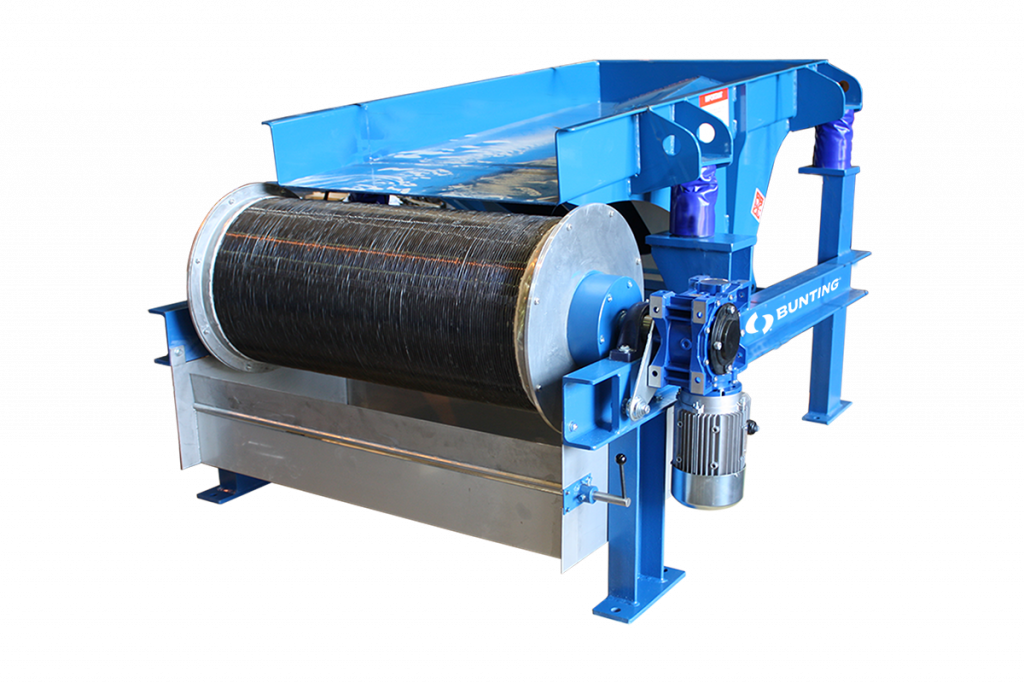
Various magnetic field configurations are possible, but the most suitable for removing iron from bulk powders is a radial magnetic field. This ensures that once captured, the fine iron does not leave the drum surface until it moves out of the magnetic field. The wire wrapped drum magnet design increases the intensity of the field to separate weakly magnetic particles and paramagnetic minerals.
There are two main challenges when processing bulk powders on a drum magnet.
-
Vibratory feeder
Feed it evenly
The vibratory feeder should have an air bed to produce a consistent feed of powder. Standard vibratory feeders may deliver powder in clumps, significantly affecting separation performance.
-
Drum shell
Run the shell fast
The drum shell should rotate at high speed. This causes some of the powder to plume, which is minimized by keeping the gap between the end of the feeder tray and the drum surface as small as possible.
High rotation speed significantly reduces the amount of product lost to the magnetics, because there is less material on the drum surface at any one time and less chance of entrapment.
Proven in: removing fine iron from abrasives, refractories, and other materials with a high specific gravity.
When is an electromagnetic dry filter the right choice?
This high-intensity magnetic separator generates ultra-strong magnetic fields to capture ferrous particles in difficult-to-process fine materials. It is used in mineral processing, chemical and pharmaceutical production, ceramics, and recycling.
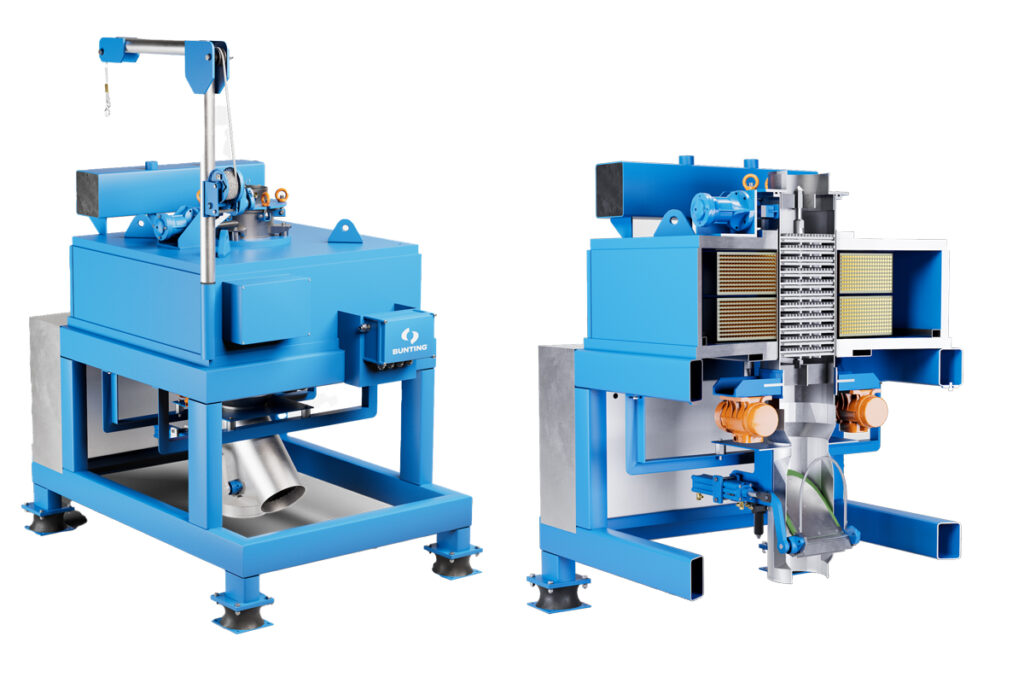
The Electromagnetic Dry Filter has a centrally located vibrating canister inside a specially designed electromagnetic coil. The coil generates between 3,500 and 5,000 gauss in the canister, which is concentrated on the points of the matrix to reach peaks of up to 12,000 gauss.
In operation, fine powder flows under gravity through the vibrating canister, which is packed with a magnetic stainless steel matrix. Magnetic particles are attracted to the magnetically induced matrix and held until the batch feed is stopped. The electromagnet is then turned off, releasing the magnetic particles into a separate waste collection area, before processing resumes.
Best fit. The Electromagnetic Dry Filter is particularly suited to purifying high-value fine powders, especially when they are processed and produced in controlled batches.
Equipment covered in this article
- Drawer Filter Magnets
- Fine iron removal from powders falling through a hopper or housing.
- Plate, Grate and Tube Magnets
- Chutes, hoppers and in-line housings.
- In-Line Magnets
- Gravity spouting and dilute phase pneumatic conveying lines.
- Drum Magnets
- Vibratory-fed, high specific gravity materials such as abrasives and refractories.
- Electromagnetic Filters
- High-value fine powders processed in batches.
- Gravity Free-Fall Metal Detectors
- Free-falling powders, such as the Performer Elite GF.
- Metal Detectors
- Removing larger tramp metal before size reduction.
How do you keep a bulk powder metal-free?
As the demand for finer and purer powders increases, so does the need to remove even the finest iron. Understanding the properties and behaviour of the powder is vitally important when choosing the optimum method of fine iron separation. Often the best solution is a series of magnetic separators and metal detectors located at strategic points within the process.
Frequently asked questions
Why is fine iron hard to remove from powders?
Grains in bulk powders cling together in clumps, which can trap fine iron among clean product and hold it out of reach of the maximum magnetic force, so it is not separated.
Should tramp metal be removed before milling?
Yes. Removing larger tramp metal before the processing stage stops it being reduced to secondary fine iron and protects crushers, shredders, and mills from damage.
What magnet strength is needed to capture fine iron?
High strength magnetic fields, as produced by Rare Earth Neodymium magnets, are needed to capture fine iron contamination.
How do you stop powder building up on tube magnets?
Allow optimum spacing between the tubes, consider an external vibrator on the hopper or housing, or use teardrop shaped tube magnets designed to stop fine powder building up on the surface.
What angle should a gravity in-line magnet be installed at?
For effective tramp metal capture, the spouting should be angled no more than 60 degrees from horizontal.