

Self-Cleaning Crossbelt Magnetic Separators
Overband Magnets
Remove Tramp Iron. Protect Your Equipment.
Lift ferrous metal from conveyed material and discharge it automatically. Compare Bunting permanent and electromagnetic options, then get a recommendation for your conveyor.
No model number or complete specification required.
Find Your Starting Point
Permanent And Electromagnetic Overband Magnets
All four discharge captured ferrous metal automatically. Start with the installation and separation duty below.
| Feature | Permanent (PCB) | ElectroMax (EMAX) | Oil-Cooled (OCW) | Air-Cooled (ACW) |
|---|---|---|---|---|
| Consider For | Mobile crushers, screeners and recycling | More magnetic power where space and weight matter | Deep material beds and heavy-duty extraction | Heavy-duty separation with an oil-free magnet |
| Magnetic Field | Permanent; no electrical supply for field | Powered electromagnetic coil | Powered electromagnetic coil | Powered electromagnetic coil |
| Cooling Method | No coil cooling required | Air; no oil in magnet | Oil | Air; no oil in magnet |
| Conveyor Belt Width | 300–2,000 mm Approx. 12–79 in. | 1,000–1,800 mm Approx. 39–71 in. | 500–3,000 mm Approx. 20–118 in. | 500–3,000 mm Approx. 20–118 in. |
| Operating Height, Up To | 400 mm Approx. 16 in. | 600 mm Approx. 24 in. | 1,000 mm Approx. 39 in. | 1,000 mm Approx. 39 in. |
| Options To Discuss | Sizes and configurations to suit your installation | Armored belt | Armored belt; ATEX-rated models | Extension magnets for a longer discharge zone |
On smaller screens, swipe the table to compare all four models.
Operating height is the distance from the magnet face to the belt, not the burden depth. Bunting sizes each magnet to your maximum material depth, density, belt speed and target metal. Every model uses a driven self-cleaning belt.
Permanent Magnetic Field
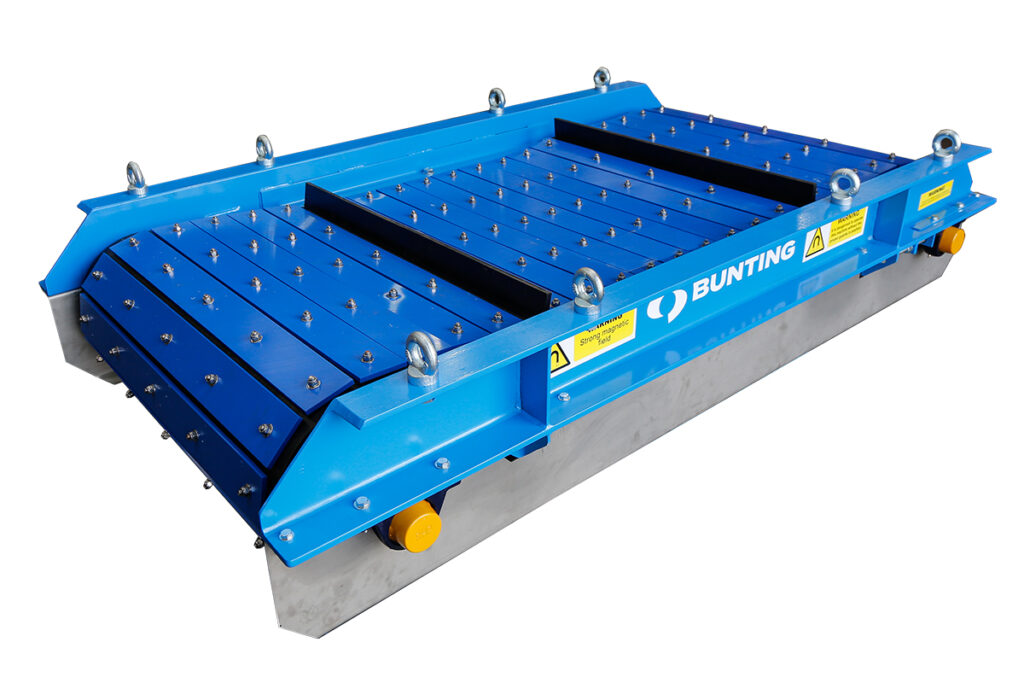
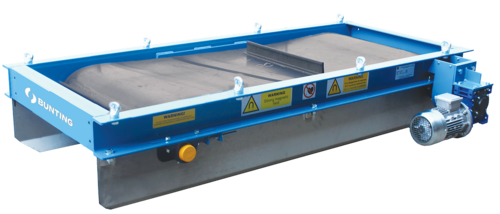
Permanent Overband (PCB)
Heavy-duty permanent range for recycling and quarrying, with selections available from stock.
Compact Air-Cooled Electromagnet
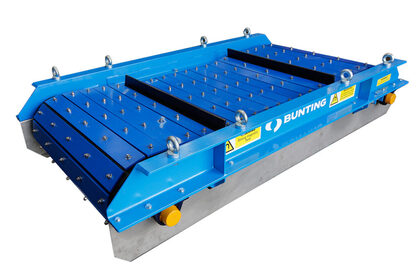
ElectroMax (EMAX)
Lightweight air-cooled electromagnet with a low-profile design and no oil.
Heavy-Duty Electromagnet
Oil-Cooled Overband (OCW)
Heavy-duty range in over 300 sizes, with ATEX-rated models available.
Heavy-Duty Electromagnet
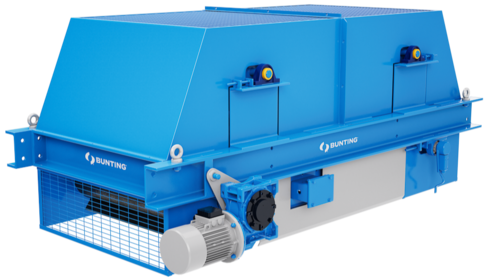
Air-Cooled Overband (ACW)
Heavy-duty range in over 300 sizes, with extension magnets for a longer discharge zone.
Confirm current stock availability and lead time for the selected PCB configuration.
Construction and Belt Options
- Ceramic or high-intensity rare earth magnets for permanent magnetic separation.
- Stainless steel frames avoid side-frame magnetization and stray-metal collection.
- UHMW belt skirting helps keep material out from between the magnet and belt.
- Abrasion-resistant SBR (styrene butadiene rubber) or urethane-coated belts.
Options depend on the selected model and application.
ElectroMax Air-Cooled Electromagnetic Overband
More Magnetic Power. Compact Design. No Oil Cooling Required.
ElectroMax provides greater magnetic power than comparable permanent overbands in a compact, low-profile design. Its air-cooled magnet needs no oil or conservator tank.
- Additional magnetic power for challenging ferrous removal
- Compact design where headroom and suspended weight matter
- Air cooling without oil in the magnet
Materials And Processing Applications
Where Overband Magnets Are Used
Mobile Crushing And Screening
Lift tramp iron from conveyors to help protect downstream crushing and screening equipment.
Aggregates And Quarrying
Remove ferrous contaminants from conveyed stone and aggregate before further processing.
Mining And Minerals
Extract tramp iron from conveyed ore and minerals to help protect crushers and other processing equipment.
Construction And Demolition Recycling
Separate ferrous metal from conveyed demolition material for recovery and equipment protection.
Mixed Waste And Recycling
Recover ferrous metal from mixed material streams and remove it before downstream processing.
Wood, Mulch And Biomass
Remove ferrous contaminants from conveyed wood and mulch before further processing.
Overbands target magnetically responsive iron and steel. For aluminum, copper or non-magnetic stainless steel, ask Bunting about additional separation or detection equipment.
Selection Guidance And Application Proof
Learn More About Overband Selection
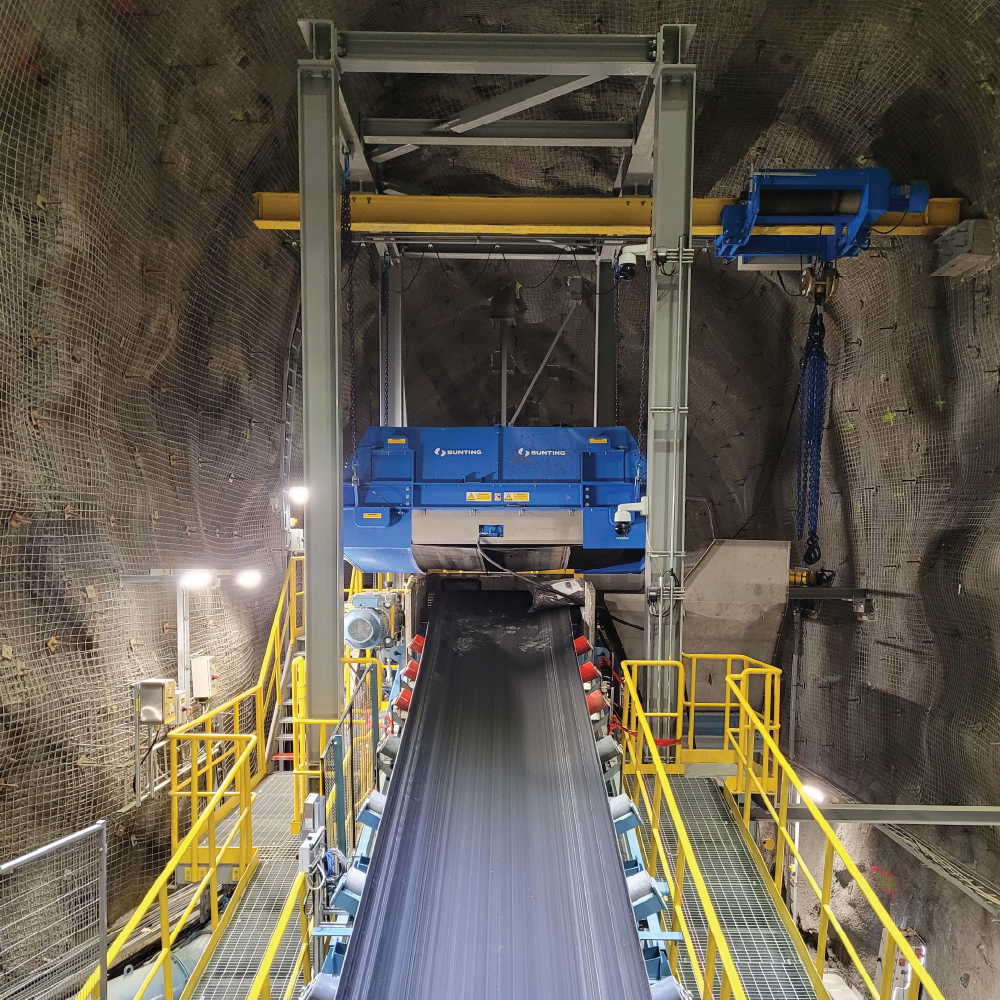
Technical Article
How to Choose the Right Electromagnetic Overband Magnet
Compare air-cooled and oil-cooled options, then review suspension height, burden depth, belt speed and installation constraints.
Read The Selection Article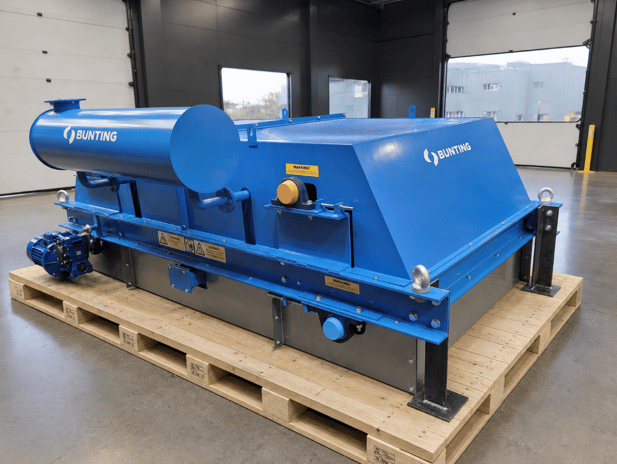
Case Study
Protecting Wood Chip Processing with Inline Magnetic Separation
See how a customized inline oil-cooled overband removes ferrous contamination from virgin and recycled wood chips.
Read The Wood Chip Case StudyEquipment In Application
Overband Magnets In Application
See conveyor installations and removed tramp metal. Select a featured photo or browse the full gallery.
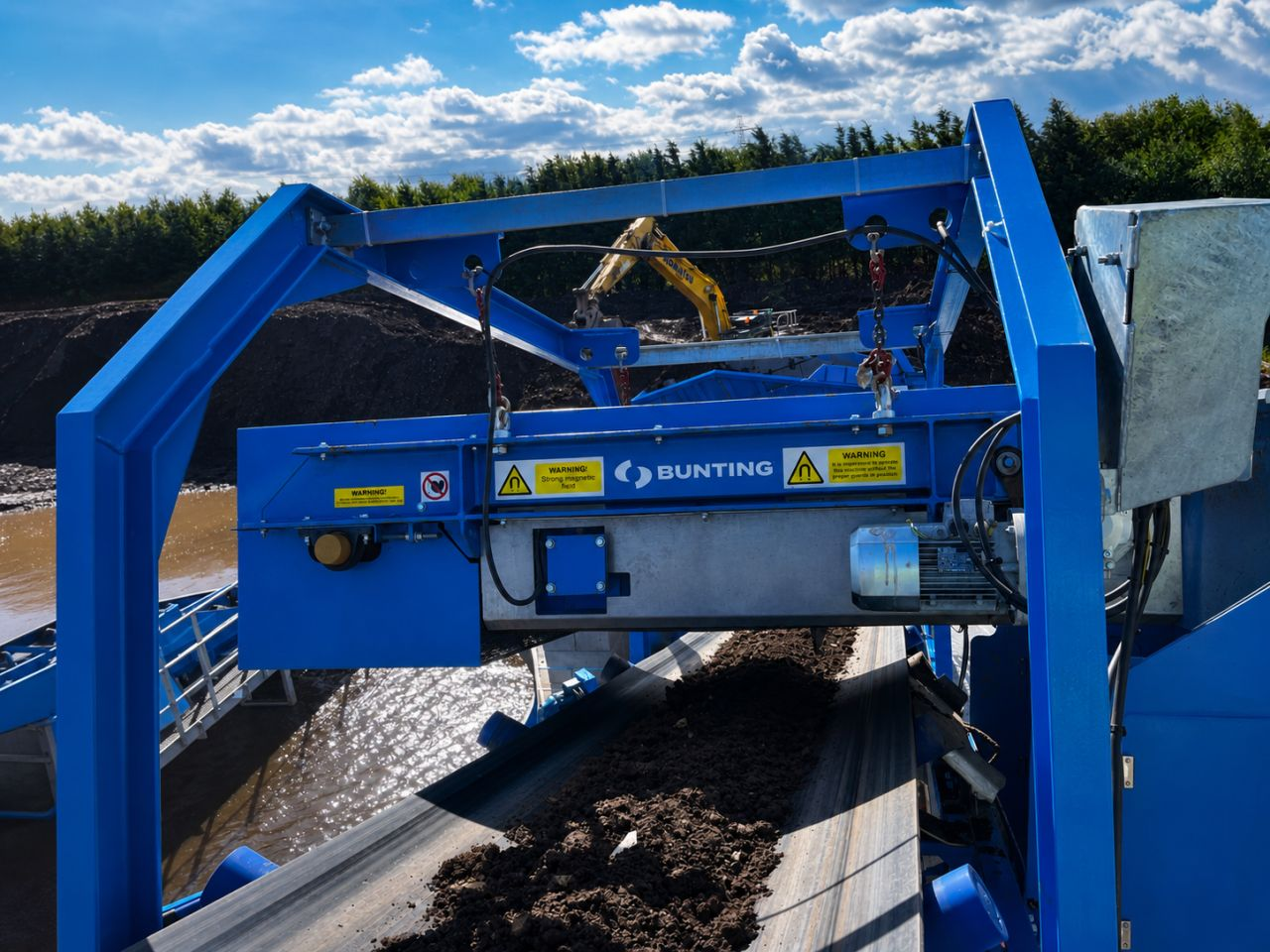
EMAX Overband on an Outdoor Conveyor
EMAX overband mounted above an outdoor conveyor carrying material.
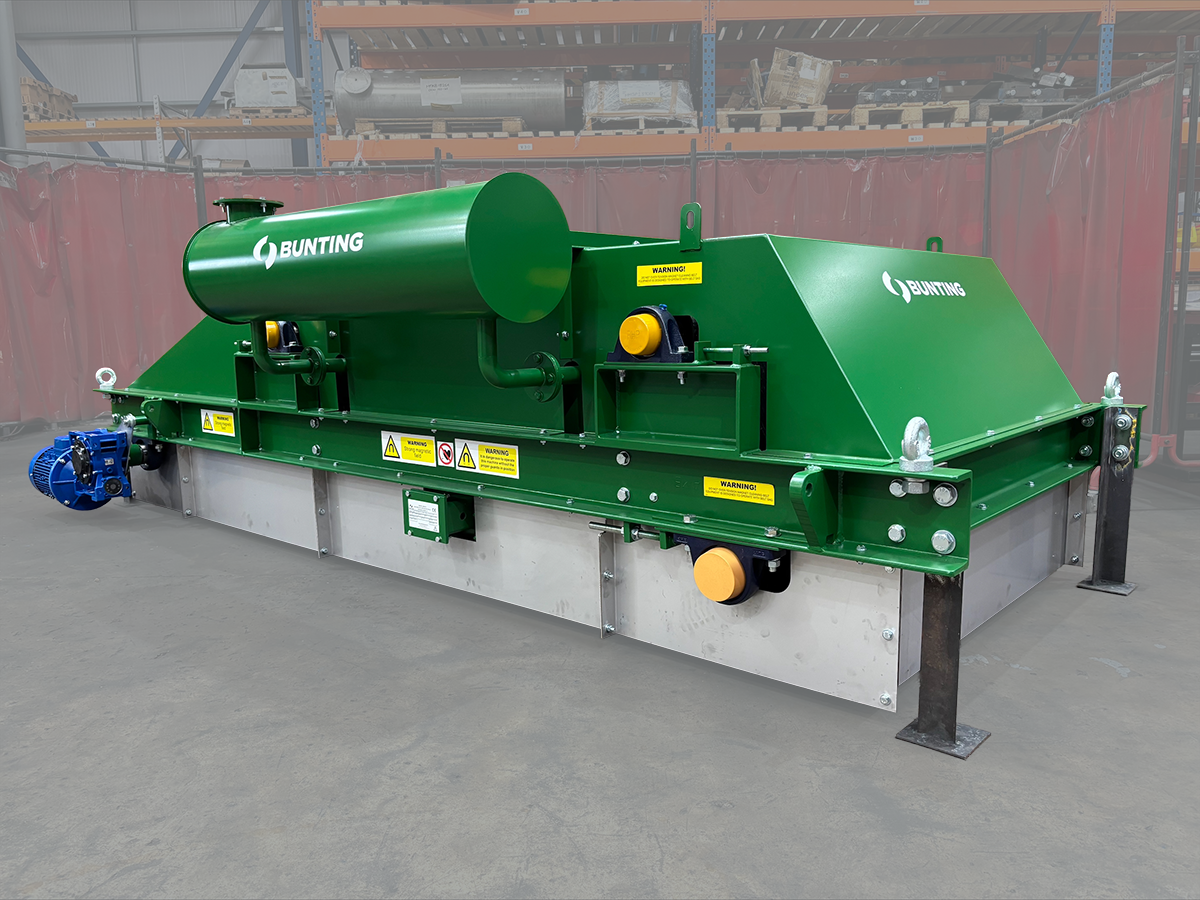
Oil Cooled Electro Overband Magnet Project
Custom oil-cooled overband with a permanent extension magnet for shredded household waste.
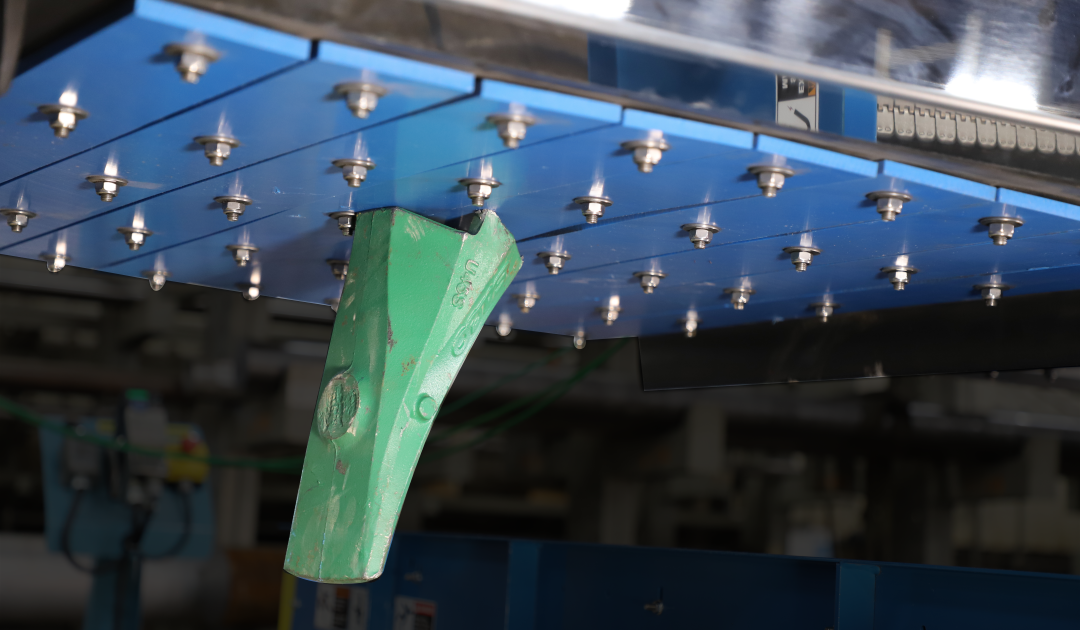
EMAX With Armored Belt
A large digger tooth captured by an EMAX fitted with the armored cladded belt option. This demonstration shows the size of tramp metal the magnet can reach; performance depends on the installation and material conditions.
Placement & Configurations
Choose the mounting arrangement around your conveyor layout and metal discharge area.
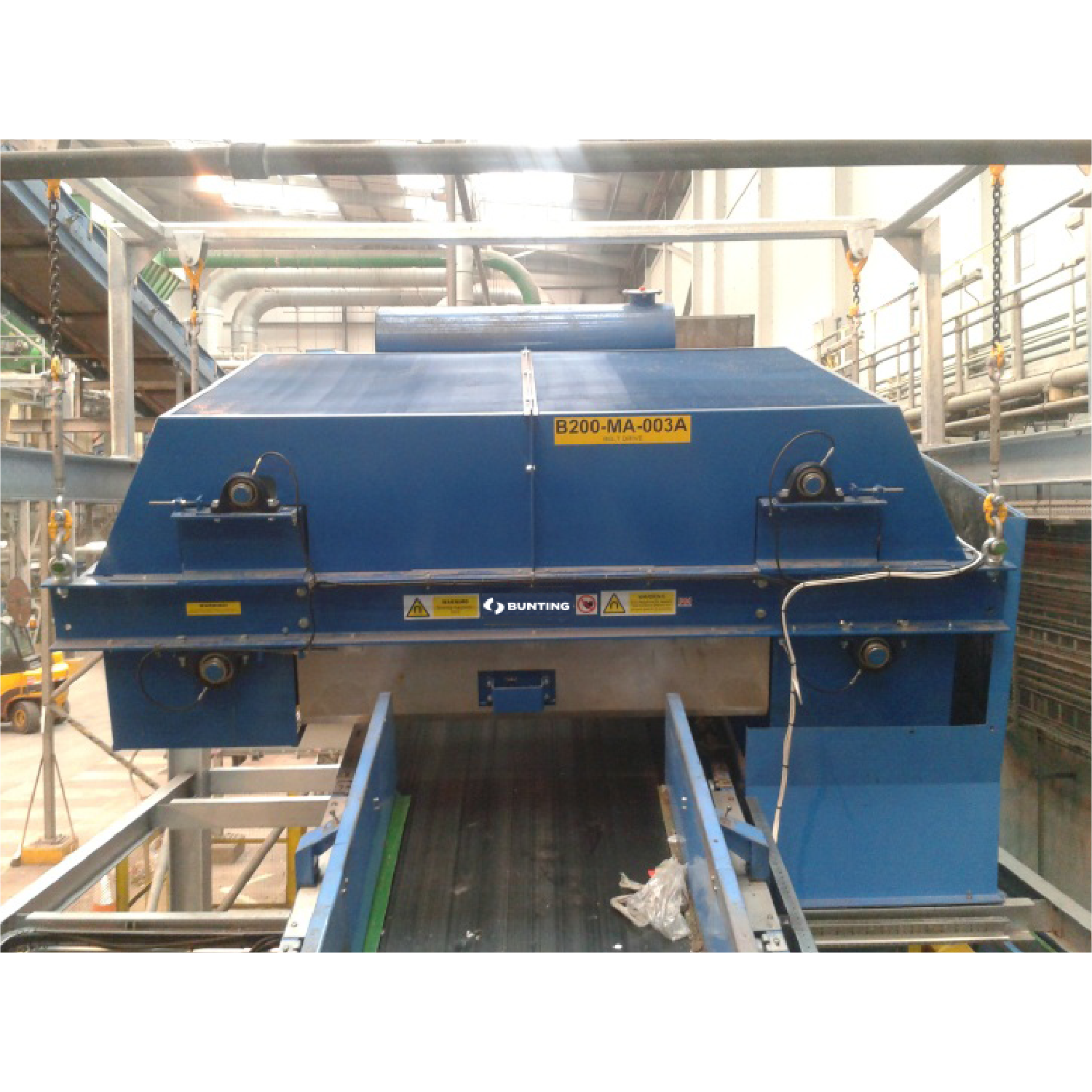
Cross-Belt (Transverse) Arrangement
Mounted across the conveyor, the overband discharges captured metal to the side. This arrangement often fits existing lines and keeps the metal collection area beside the conveyor.
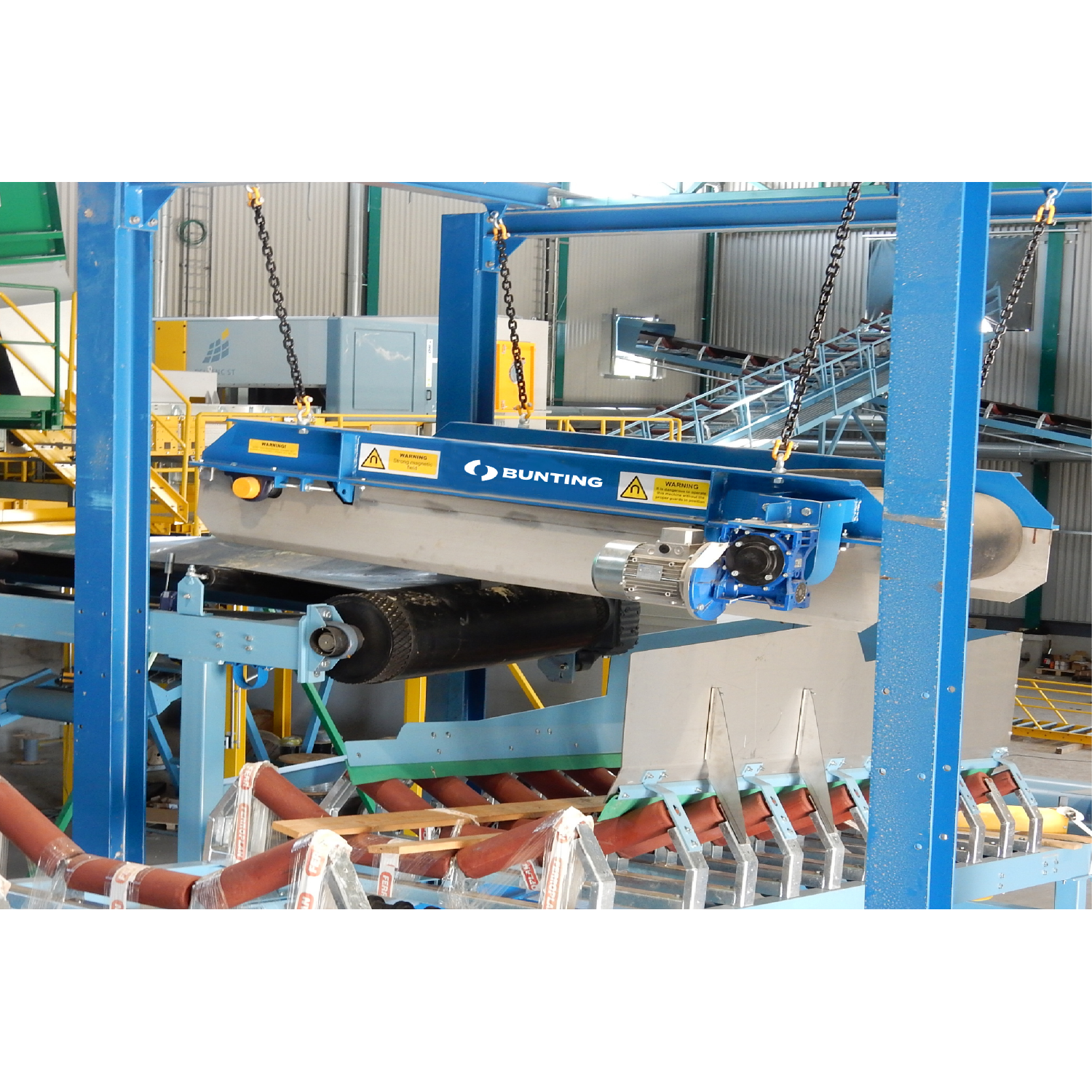
In-Line (Longitudinal) Arrangement
Mounted lengthwise above the conveyor head pulley, the overband extracts metal as material leaves the belt. The material opens up at discharge, helping release embedded metal. This arrangement is often preferred where space and the discharge layout allow.
Key Installation Guidelines
- Height And Clearance
- Use the specified operating height and keep the magnet close enough for effective separation. Increasing the distance reduces magnetic attraction. Leave clearance for the material burden, self-cleaning belt and cleats; check the height regularly.
- Center Alignment
- Center the magnet over the conveyor width. Off-center placement weakens the reach to metal on the opposite side of the belt.
- Ferrous-Free Zone
- Keep steel idlers, frames, side skirts and chutes out of the working magnetic field. Use suitable non-magnetic components within the required zone so nearby steelwork does not become magnetized and compete with the separator.
- Adjustable Suspension
- Use the mounting and suspension hardware specified for your magnet. An adjustable arrangement, such as turnbuckles where specified, allows the operating height and angle to be set correctly.
Bunting confirms the operating height, ferrous-free zone, support and discharge clearance for your installation. For more guidance, read Overband Magnet Installation Problems and Ferrous-Free Zones And Conveyor Design.
Let Bunting Confirm The Fit
Get An Overband Recommendation
Tell us your material and the metal you need to remove. Add conveyor details if you know them. We’ll help identify the magnet type, size and mounting arrangement.
A conveyor photo or drawing can help. You do not need to choose a model first.
Americas 1-800-835-2526
Outside The Americas +44 (0) 1527 65858
Tell Us About Your Application
Overband Magnet Questions
How Does An Overband Magnet Work?
The suspended magnet lifts ferrous metal from the material below. Its moving belt carries that metal out of the magnetic field and discharges it clear of the product stream.
Crossbelt mounting places the overband across the conveyor. Inline mounting aligns it with material travel. Bunting reviews clearance, support, service access and the metal collection area with your layout.
What Is An Overband Magnet?
An overband magnet is a self-cleaning magnetic separator suspended above a conveyor. It lifts ferrous metal from the conveyed material. A moving belt carries captured metal out of the magnetic field and discharges it away from the product stream.
Is A Crossbelt Magnet The Same As An Overband Magnet?
Crossbelt magnet is a common name for an overband installed across the main conveyor. Overband separators can also be installed inline. The mounting arrangement determines where captured metal is discharged.
Should I Choose A Permanent Or Electromagnetic Overband?
Consider a permanent PCB overband for mobile crushers and screeners, belts up to 2,000 mm (79 in.) and operating heights up to 400 mm (16 in.). Its magnetic field needs no electrical power. Consider an electromagnet for deeper burdens or higher mounting, with OCW and ACW operating heights up to 1,000 mm (39 in.) and belts up to 3,000 mm (118 in.). Bunting will recommend the model for your conveyor.
Does A Permanent Overband Need Power?
The permanent magnetic field does not require electrical power. The self-cleaning discharge belt requires a drive. Confirm the complete drive and power arrangement for the selected installation.
Can An Overband Remove Aluminum, Copper Or Stainless Steel?
Overband magnets target magnetically responsive ferrous metal, including iron and steel. They are not a general solution for aluminum, copper or non-magnetic stainless steel. Describe all target metals so Bunting can review additional separation or detection equipment.
What Is The Difference Between Air-Cooled And Oil-Cooled Overbands?
Both use electromagnetic coils. ACW uses air cooling without oil in the magnet cooling system. OCW uses oil cooling. The choice depends on the separation duty, installation and operating conditions. ElectroMax is a compact air-cooled electromagnetic option.
How High Should An Overband Be Suspended?
As close to the material as your deepest burden and the required belt clearance allow, at the specified operating height. Selection-guide operating heights are up to 400 mm (16 in.) for PCB, 600 mm (24 in.) for ElectroMax, and 1,000 mm (39 in.) for OCW and ACW. Share your conveyor layout, burden depth and belt speed, and Bunting will size the magnet and set the height.
What Information Do I Need To Request A Recommendation?
Start with the material you convey, the metal you want to remove and the equipment you need to protect. Add belt width, belt speed, maximum material depth and installation clearance if known. You can request a recommendation without a model number or a complete specification.
Can I Test My Material Before Selecting Equipment?
Discuss your material, target metal and separation goal with Bunting to agree on a suitable test approach before arranging a sample shipment.
Discuss Material TestingExplore magnetic separation options and metal detection.