

Food safety guidance: Metal detection systems play a critical role in helping food manufacturers identify metal contamination, support food safety plans, meet retailer codes of practice, and reduce recall risk.
Metal detection systems for food processing play an important role in modern food production. Positioned correctly, specified properly, and tested routinely, they help manufacturers protect consumers, meet customer requirements, support food safety controls, and reduce the risk of costly product recalls.
For many food processors, metal detection is not simply an equipment purchase. It is part of a wider contamination control strategy that includes supplier management, good manufacturing practice, preventative maintenance, magnetic separation equipment, operator training, documentation, and corrective action procedures.
When used correctly, a food metal detector gives manufacturers a reliable method of identifying and rejecting products contaminated with ferrous, non-ferrous, or stainless steel metal. When used poorly, it can become little more than a compliance tick box, creating a false sense of security.
This guide explains how metal detection systems work in food production, what affects their performance, how customer sensitivity requirements are set, where detectors should be installed, and how to validate metal detection as part of a robust food safety program.
Contents
- What Is a Food Metal Detection System?
- How Do Metal Detectors Work in Food Lines?
- What Types of Metal Can Food Metal Detectors Detect?
- Why Product Effect Matters in Metal Detection
- Where Should Metal Detectors Be Installed?
- Metal Detection vs Magnetic Separation
- How Metal Detectors Support Food Safety Plans
- Retailer and Customer Requirements
- How to Specify a Metal Detector
- Validation vs Verification
- Testing Frequency
- Metal Detector Test Records
- What Happens If a Test Fails?
- Improving Metal Detection Performance
- Why Choose Bunting?
- Frequently Asked Questions
What Is a Food Metal Detection System?
A food metal detection system is an inspection system designed to identify metal contamination in food products as they move through a production line. In food applications, metal detectors are commonly installed on conveyors, gravity-fed lines, pipeline systems, or final pack inspection points.
The detector is typically connected to a reject mechanism or line stop system. When metal is detected, the contaminated product is removed from the production flow or isolated for investigation.
Food metal detectors are used to detect:
- Ferrous metal, such as iron and mild steel
- Non-ferrous metal, such as copper, brass, and aluminum
- Stainless steel, including fragments from processing equipment
In food production environments, metal contamination can come from many sources. Common examples include broken screens, worn cutting blades, damaged machinery, metal-to-metal contact, maintenance tools, raw material contamination, and packaging line components.
How Do Metal Detectors Work in Food Lines?
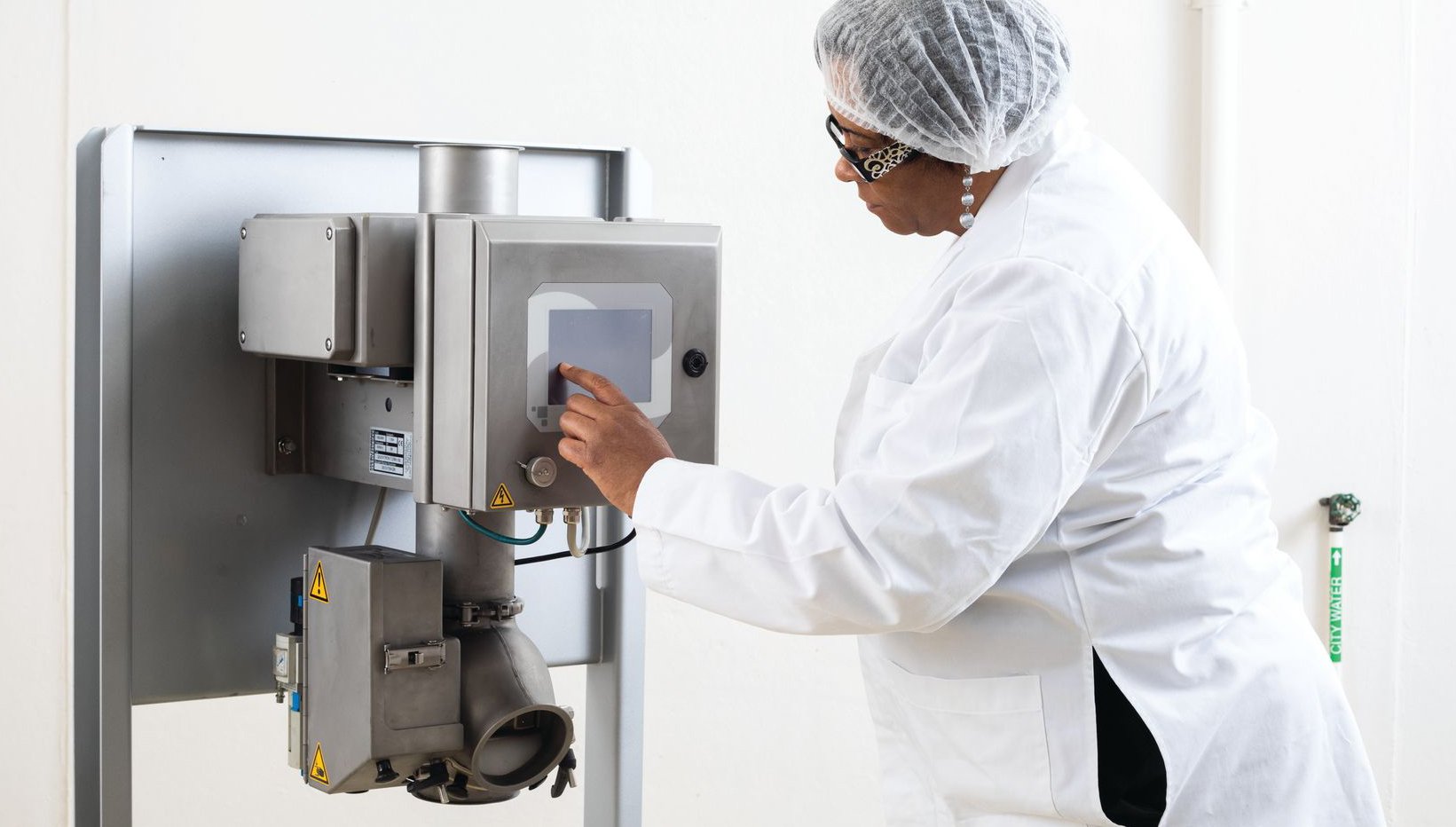
Most food-grade metal detectors operate using a balanced coil system. The search head contains three coils arranged in a precise configuration. The center coil acts as the transmitter, while the two outer coils act as receivers.
When no metal is present, the signals from the receiver coils balance each other out. During setup, the detector is tuned to the normal electromagnetic signal created by the product and packaging. This product profile helps the detector understand what the product should look like as it passes through the aperture.
If a metal contaminant passes through the detector, it disrupts the electromagnetic field. When that signal falls outside the tuned product profile and programmed detection threshold, the detector identifies the event and triggers the required response.
Depending on the line configuration, that response may be an alarm, reject device, belt stop, or another control action. The aim is not only to detect metal, but to ensure the affected product is removed from the production flow or isolated for investigation.
For packaged or unpackaged products moving on a conveyor, conveyor metal detectors are commonly used. For products moving through enclosed pipework or pumped systems, inline metal detectors may be more suitable.
What Types of Metal Can Food Metal Detectors Detect?
Food metal detectors can detect ferrous, non-ferrous, and many stainless steel contaminants. However, sensitivity varies depending on the type of metal, the size of the contaminant, the orientation of the fragment, the product being inspected, and the detector setup.
Ferrous metals are usually the easiest to detect because they are both magnetic and conductive. Non-ferrous metals are also conductive and can often be detected effectively. Stainless steel is usually the most difficult, especially when the fragment is small or when the product itself creates a strong background signal.
This is why food manufacturers should avoid relying only on quoted sensitivity figures from dry test samples. The true measure of performance is how the detector performs on the actual product, in the actual packaging, at the actual production speed.
Why Product Effect Matters in Metal Detection
Product effect is one of the most important factors in food metal detection. It describes the background signal generated by the product itself as it passes through the detector.
Products with high moisture, salt, acidity, or temperature can behave in a conductive way. This can make it more difficult for the detector to distinguish between normal product signal and a small metal contaminant.
Common products affected by product effect include:
- Fresh meat and poultry
- Ready meals
- Cheese and dairy products
- Bakery products with high moisture content
- Sauces, soups, and prepared foods
- Products packed hot or warm
- Products with high salt content
Modern food metal detectors use frequency selection, signal processing, phase adjustment, product learning, and digital filtering to reduce the impact of product effect. In more challenging applications, multi-frequency technology may be used to improve detection stability across a wider range of products.
For plant managers, the key question is not simply, “What is the smallest piece of metal this detector can find?” A better question is, “What sensitivity can this detector reliably achieve on our product, in our packaging, at our production speed, while remaining stable in normal operation?”
Where Should Metal Detectors Be Installed on a Food Production Line?
The best location for a metal detector depends on the process, the product, and the contamination risk.
Many food manufacturers install metal detectors as late as possible in the process, often after final packaging. This gives the system the opportunity to inspect the finished pack before it is boxed, palletized, or dispatched. Tunnel-style metal detectors and conveyor systems are commonly used for this type of final pack inspection.
However, there are also strong reasons to install metal detection earlier in the process. For example, a detector may be placed after grinding, mixing, slicing, or bulk handling where the risk of metal contamination is higher. In some plants, multiple inspection points are used because different stages of the process carry different risks.
| Inspection Point | Purpose | Typical Equipment |
|---|---|---|
| Raw material intake | Identify contamination before ingredients enter the main process | Gravity or conveyor metal detector, magnetic separator |
| After cutting, grinding, or mixing | Check higher-risk stages where equipment wear may introduce metal | Conveyor or pipeline metal detector |
| Before final packing | Inspect product before it enters final packaging | Conveyor metal detector |
| After final packaging | Inspect finished packs before dispatch | Tunnel-style conveyor metal detector |
| Before bulk loading or bag filling | Protect bulk product quality before shipment or storage | Gravity free-fall or conveyor metal detector |
For powders, granules, flakes, and bulk dry ingredients, gravity free-fall metal detectors may be used where product drops through the inspection zone before bagging, bulk loading, or further processing.
Metal detection should also be considered alongside magnetic separation. Magnetic separators can remove ferrous and weakly magnetic metal before the product reaches critical equipment or final inspection. Used together, magnetic separation and metal detection for food processing provide a stronger contamination control strategy than either system used alone.
Metal Detection vs Magnetic Separation in Food Processing
Metal detection and magnetic separation are complementary technologies. They are often used together because each performs a different role in a complete foreign body control program.
| Technology | Primary Role | Best Used For | Typical Location |
|---|---|---|---|
| Magnetic Separation | Removes ferrous and weakly magnetic metal contamination | Protecting equipment and reducing metal burden before inspection | Raw ingredient intake, hoppers, chutes, pipelines, and transfer points |
| Metal Detection | Detects ferrous, non-ferrous, and stainless steel contamination | Final inspection, packaged product checks, and compliance control points | Conveyor lines, gravity-fed lines, pipeline systems, and final pack inspection |
For dry ingredients moving through chutes, hoppers, or gravity-fed lines, plate, grate, and tube magnets can help remove ferrous contamination earlier in the process. For liquids, sauces, slurries, and pumped food products, liquid magnetic separators can provide upstream protection before final metal detection.
How Do Metal Detectors Support Food Safety Plans?
Metal detectors support food safety plans by helping manufacturers identify and control the risk of metal contamination. In many food plants, metal detection forms part of a documented food safety plan and may be defined as a critical control point, quality control point, or prerequisite control depending on the site’s risk assessment and customer requirements.
To support compliance, the system must do more than simply detect metal. It must be specified, installed, validated, tested, maintained, and documented correctly.
A compliant metal detection program should define:
- The metal types and test piece sizes that must be detected
- The products and pack sizes covered by the detector
- The detector settings and product profiles
- The reject or line stop procedure
- The test frequency
- The operator responsibilities
- The record-keeping process
- The corrective action process after a failed test or detection event
- The maintenance and calibration schedule
Auditors, customers, and retailers often expect evidence that the system works under real production conditions. This means food manufacturers must be able to demonstrate both validation and ongoing verification.
How Do Metal Detectors Help Meet Retailer and Customer Requirements?
Retailers, brand owners, and food manufacturers’ customers often include specific foreign body control requirements in their supplier codes of practice. These requirements may define minimum detectable test piece sizes for ferrous, non-ferrous, and stainless steel contaminants.
In practice, sensitivity targets are often set by the food manufacturer’s customer. For example, a retailer or brand owner may require a product to achieve defined ferrous, non-ferrous, and stainless steel test piece sizes before approval. A typical customer specification may require separate targets such as 2 mm ferrous, 2 mm non-ferrous, and 3 mm stainless steel, although the exact requirement will vary by product, customer, and risk assessment.
When specifying a metal detector, food manufacturers should compare supplier proposals against these customer requirements. However, it is important to confirm that any quoted sensitivity can be achieved on the actual product and packaging at production speed.
A detector that performs well on an empty belt may not achieve the same result when inspecting conductive, wet, hot, or metallized products. For this reason, product testing is a critical part of the equipment selection process.
Retailer-focused metal detection systems may also require:
- Locked or password-protected settings
- Automatic product setup or product memory
- Reject confirmation
- Bin full detection
- Air pressure monitoring
- Belt stop alarms
- Audit trails
- Event logs
- Fail-safe reject systems
- Data capture for traceability
- Clear operator prompts and fault messages
These features help demonstrate that the system is not only capable of detecting metal, but also capable of controlling contaminated product if a detection event occurs.
How Should Food Manufacturers Specify a Metal Detector?
Specifying the right metal detector starts with understanding the product, the process, and the customer or compliance requirements.
Product and Packaging
The product’s moisture, salt content, temperature, density, and packaging all affect metal detector performance. Products in foil trays, metallized film, aluminum packaging, or other metal-containing packaging may require a different inspection approach.
Where conventional metal detection is not suitable because of the packaging format, food manufacturers may need to consider X-ray inspection or another specialist inspection method. Packaging should be reviewed early during specification rather than after the detector has already been selected.
Aperture Size
The detector aperture should be large enough for the product to pass through safely, but not oversized. As a general rule, larger apertures reduce sensitivity. Selecting the correct aperture height and width is one of the most important steps in achieving reliable detection.
Line Speed and Product Spacing
The detector and reject system must be matched to the speed of the production line. Products must be spaced correctly so the reject mechanism can remove the contaminated pack without affecting neighboring packs.
Environment
Food production environments can include washdown areas, temperature changes, vibration, electrical noise, and strict hygiene requirements. The detector frame, conveyor, belt, guards, and reject system should suit the cleaning regime and production environment.
Reject System
The correct reject system depends on the product format. Common reject options include air blast, pusher, retracting band, drop flap, diverter arm, stop-on-detect, or lockable reject bins.
Controls and Traceability
Modern metal detection systems can store product profiles, protect settings with passwords, generate logs, and connect to factory data systems. These features are especially useful where retailer audits and traceability requirements are demanding.
What Is the Difference Between Validation and Verification?
Validation and verification are often used together, but they are not the same.
Validation proves that the metal detection system can detect the agreed test pieces under real production conditions. This is normally completed during installation, commissioning, product trials, or after major changes to the line.
Verification proves that the detector continues to perform as expected during routine production. This is normally done through scheduled checks using certified test pieces.
| Term | What It Proves | When It Happens |
|---|---|---|
| Validation | Confirms the metal detector can detect the required test pieces under real production conditions | During installation, commissioning, product trials, or after major process changes |
| Verification | Confirms the detector continues to perform correctly during routine production | During scheduled checks using certified test pieces |
In simple terms:
- Validation asks: Can the system detect the required metal contaminants?
- Verification asks: Is the system still detecting them today, on this product, during production?
Both are essential for a strong food safety and compliance program.
How Often Should Food Metal Detectors Be Tested?
Many food manufacturers test metal detectors at start-up, during product changeovers, at defined production intervals, and at the end of a run. Hourly checks are common in many food plants, but the correct frequency should be based on product risk, customer requirements, line history, and the consequences of a detection failure.
A typical test routine may include:
- Start of production
- Product changeover
- Regular production intervals
- After a break or stoppage
- After maintenance or cleaning
- End of production
Each test should confirm that the detector identifies the correct ferrous, non-ferrous, and stainless steel test pieces and that the reject system operates correctly.
Where the detector is used as part of a critical control point, records must be clear, complete, and available for audit.
What Should Be Recorded During Metal Detector Testing?
A metal detector test record should provide enough detail to prove that the system was working correctly at the time of inspection.
Records may include:
- Date and time of the test
- Line number or detector identification
- Product name or product code
- Pack size
- Operator name
- Test piece type and size
- Detector settings or product profile
- Pass or fail result
- Reject confirmation result
- Corrective action taken
- Supervisor sign-off where required
Electronic records can help reduce paperwork and improve traceability. However, the system must still be easy for operators to use correctly during busy production periods.
What Happens If a Metal Detector Test Fails?
A failed metal detector test must be treated seriously. If a detector fails to identify a test piece, fails to reject correctly, or behaves inconsistently, production should be stopped or controlled according to the site procedure.
The affected product should be isolated from the last successful check. The detector should then be investigated, corrected, and revalidated before production restarts.
Typical corrective actions include:
- Quarantining product produced since the last successful test
- Checking the detector settings and product profile
- Inspecting the reject mechanism
- Confirming air pressure or belt stop operation
- Reviewing product temperature or presentation
- Checking for vibration or electrical interference
- Re-running test pieces through the system
- Recording the root cause and corrective action
A strong procedure protects the consumer, supports audit compliance, and helps the site identify recurring issues before they become larger problems.
How Can Food Manufacturers Improve Metal Detection Performance?
Metal detection performance can be improved through correct specification, installation, testing, and maintenance.
Best practice steps include:
- Keep the detector aperture as small as practical
- Present products consistently through the center of the aperture
- Use stable belt speeds and correct product spacing
- Control vibration around the search head
- Maintain the required metal-free zone
- Use the correct product profile
- Keep test pieces secure and in good condition
- Train operators on both testing and corrective action
- Review detection trends and recurring reject events
- Service and calibrate the system according to the supplier’s guidance
Where ferrous metal risk is significant, installing magnetic separation equipment upstream can reduce the metal burden before final inspection. This helps protect processing equipment and may reduce repeated rejects caused by larger ferrous contamination.
Why Choose Bunting for Food Metal Detection?
Bunting designs and supplies metal detection systems and magnetic separation equipment for food processing and packaging applications. Our equipment supports manufacturers that need to improve product purity, protect consumers, reduce contamination risk, and meet customer or retailer expectations.
Every food production line is different. Product type, packaging, belt speed, hygiene requirements, available space, and audit expectations all affect the best inspection solution. Bunting works with processors to understand the application and recommend equipment that fits the process, not just the specification sheet.
Whether you are replacing an older detector, adding a new inspection point, improving food safety controls, or reviewing foreign body prevention across a production facility, Bunting can help assess the application and identify a practical metal detection solution.
Frequently Asked Questions
Getting the Specification Right
Metal detection is most effective when the system is selected around the real conditions on the production line. Product type, packaging, belt speed, aperture size, reject method, hygiene requirements, and retailer expectations all affect how well a detector will perform in practice.
A detector that performs well on an empty belt or a dry test sample may not achieve the same sensitivity when inspecting real product at full production speed. This is why product testing, correct installation, validation, routine checks, and clear records are all essential parts of a reliable metal detection program.
Bunting can help assess your product, line layout, inspection point, and compliance requirements to identify a practical metal detection solution. For support with a new installation or a review of an existing system, contact Bunting’s technical team.