
Updated for 2026: Food processors continue to increase investment in magnetic separation and metal detection systems to improve food safety, reduce contamination risk, protect downstream equipment, and support modern HACCP and quality assurance programs.
Improve Food Processing with Bunting Metal Detection and Magnetic Separation
Metal contamination control is essential in food processing. Bunting helps food manufacturers protect product quality, reduce contamination risk, and safeguard processing equipment using integrated magnetic separation and metal detection systems.
Food processing facilities face contamination risks at multiple points in the production line. Ferrous metal, non-ferrous metal, and stainless steel contamination can enter a process through raw ingredients, worn equipment, processing machinery, packaging stages, or maintenance activities.
A strong food safety program uses the right combination of magnetic separation and metal detection equipment for food processing to remove and detect metal contamination before it reaches customers or damages production equipment.
Contents
- Why Metal Contamination Control Matters
- Magnetic Separation and Metal Detection
- Perfect Plant Food Processing System
- Custom Solutions for Food Manufacturers
- Where Equipment Is Installed
- Food Processing Equipment Examples
- Benefits for Food Processors
- Frequently Asked Questions
Why Metal Contamination Control Matters in Food Processing
Metal contamination is a serious risk in food processing. If metal contamination remains in a food product, the consequences can include product recalls, damaged customer trust, brand reputation issues, and potential harm to consumers.
Metal contamination can also damage processing equipment. Undetected metal fragments can harm grinders, mixers, conveyors, pumps, slicers, packaging equipment, and other machinery. This can result in repair costs, downtime, lost production, and reduced plant efficiency.
For high-volume food manufacturers, metal contamination control is not just a quality issue. It is a production, safety, compliance, and brand protection issue.
How Magnetic Separation and Metal Detection Work Together
Magnetic separation and metal detection perform different but complementary roles in food processing.
Magnetic separators remove ferrous metal contamination from product streams. They are especially effective at capturing fine ferrous particles, work-hardened stainless steel fragments, and tramp metal before contamination reaches sensitive downstream equipment.
Metal detectors identify and reject metal contamination from product streams, including ferrous, non-ferrous, and stainless steel contamination. They are often used later in the process or at final inspection points before packaging or shipment.
Using both technologies together creates a stronger contamination control strategy than relying on either method alone.
| Technology | Main Role | Common Food Processing Use |
|---|---|---|
| Magnetic Separation | Removes ferrous contamination | Ingredient intake, transfer points, liquid lines, bulk material flow |
| Metal Detection | Detects and rejects metal contamination | Final product inspection, packaged goods, conveyor lines |
Bunting’s Perfect Plant System for Food Processing
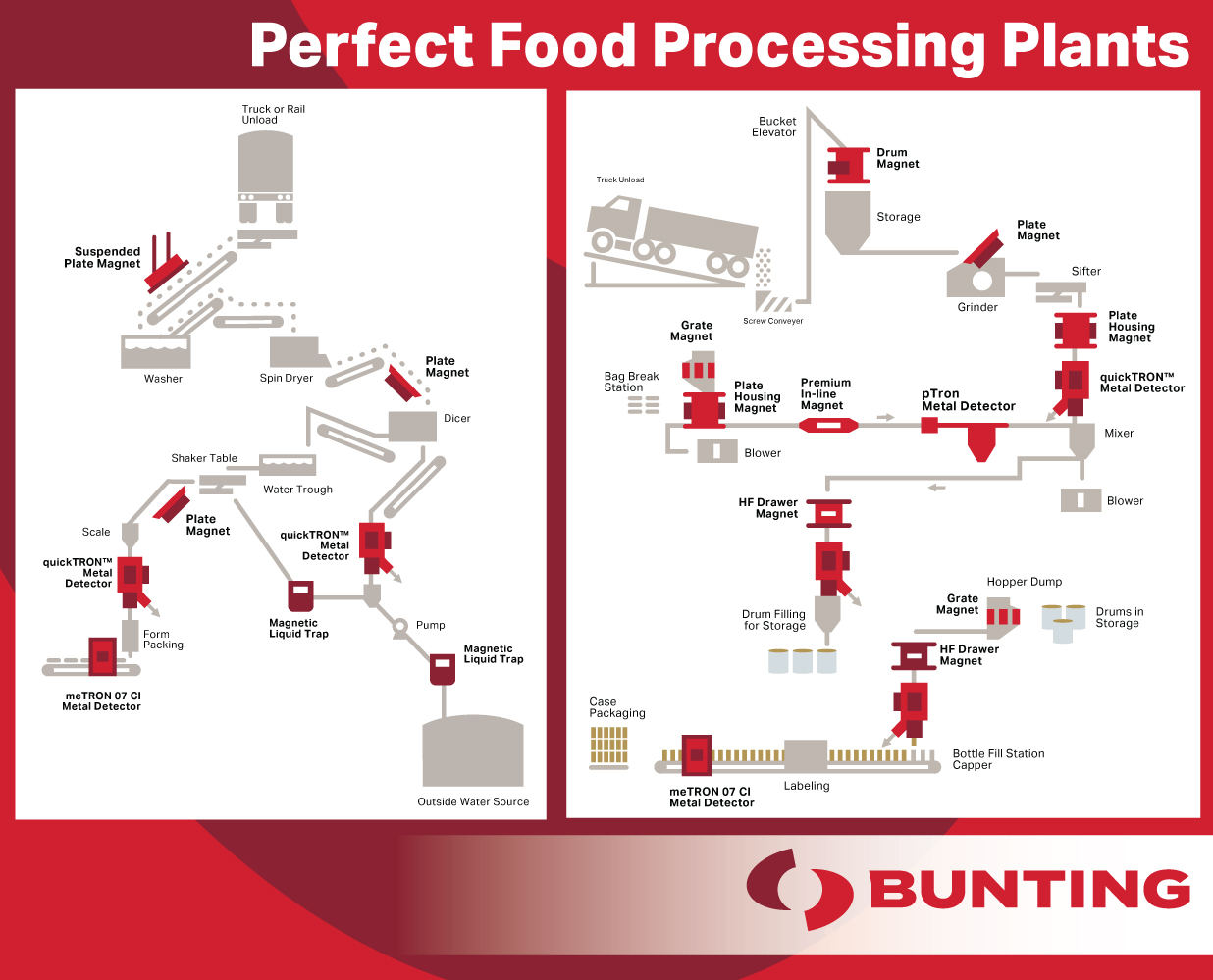
Bunting created the “Perfect Plant” concept to help food manufacturers identify the best locations for magnetic separation and metal detection equipment throughout their facilities.
Rather than relying on a single piece of equipment, a Perfect Plant approach uses multiple protection points to reduce metal contamination risk across the full process line.
This can include equipment at:
- Raw ingredient intake
- Bulk material transfer points
- Chutes, hoppers, and gravity-fed lines
- Liquid and slurry processing lines
- Conveyor systems
- Final packaged product inspection
The goal is to remove metal contamination as early as possible and provide final detection before product leaves the facility.
Custom Solutions for Food Manufacturers
No two food processing facilities are exactly the same. A bakery, cheese processing plant, vegetable processor, spice facility, brewery, meat processor, or pet food plant will each have different product characteristics and contamination risks.
Bunting engineers can help design a custom metal removal and detection solution based on the product, process flow, sanitation requirements, contamination risk, and available installation space.
Magnetic separation equipment and metal detectors work together to remove and detect contamination at multiple stages of the manufacturing process.
Magnetic separation equipment can remove fine ferrous contamination, including particles that may be invisible to the naked eye. Metal detectors can detect ferrous, non-ferrous, and stainless steel contamination, including contamination in packaged products.
Where Metal Detection and Magnetic Separation Equipment Is Installed
The correct installation point depends on the type of product and the way it moves through the facility.
Raw Ingredient Intake
Magnetic separators installed early in the process help remove tramp metal before it reaches mixers, mills, grinders, or other downstream equipment.
Gravity-Fed and Chute Applications
Plate magnets, grate magnets, and drawer magnets are commonly used where dry ingredients fall through hoppers, chutes, or bins.
Liquid and Slurry Lines
Magnetic liquid traps help remove ferrous contamination from liquid or semi-liquid food products, including acidic or challenging product streams.
Conveyor Lines
Conveyor-mounted metal detectors can identify and reject contaminated products as they move through the production line.
Final Packaged Product Inspection
Metal detectors are often used at final proofing stages to inspect finished or packaged goods before shipment.
Food Processing Equipment Examples

meatLINE™ Metal Detector
Bunting’s meatLINE™ metal detector was designed for the challenges associated with detecting and removing metal contamination in processed meat applications.
Corrosion Resistant Magnetic Liquid Trap
The Corrosion Resistant Magnetic Liquid Trap, or CR-MLT, is designed for demanding liquid food processing applications, including acidic products such as tomato or citrus-based foods.
meTRON™ 07 CI Metal Detector
The meTRON™ 07 CI Metal Detector can detect metal contamination in packaged food products, making it suitable for final inspection and proofing stages.
Bunting’s magnetic separation and metal detection equipment is designed to support food industry safety, sanitation, and quality control requirements.
Benefits for Food Processors
Integrated magnetic separation and metal detection systems provide several important benefits for food processing facilities.
- Reduced risk of metal contamination reaching customers
- Improved protection for processing equipment
- Reduced downtime caused by metal damage
- Support for food safety and quality programs
- Improved final product inspection
- Better contamination control across the full production line
By combining magnetic separators and metal detectors, food manufacturers can build a more complete contamination control strategy.
Frequently Asked Questions
Why is metal detection important in food processing?
Metal detection helps identify and reject ferrous, non-ferrous, and stainless steel contamination before food products reach customers.
Why are magnetic separators used in food processing?
Magnetic separators remove ferrous metal contamination from ingredients and product streams, helping protect both product quality and downstream equipment.
Should food processors use both magnetic separators and metal detectors?
Yes. Magnetic separators remove ferrous contamination, while metal detectors identify a wider range of metal contaminants, including non-ferrous and stainless steel.
Where should magnetic separators be installed in a food plant?
Magnetic separators are commonly installed at raw ingredient intake, transfer points, chutes, hoppers, liquid lines, and before sensitive downstream equipment.
Where should metal detectors be installed in a food plant?
Metal detectors are often installed on conveyor lines, after key processing stages, and at final inspection points before packaging or shipment.
What is Bunting’s Perfect Plant concept?
Bunting’s Perfect Plant concept shows how magnetic separation and metal detection equipment can be positioned throughout a food processing facility to reduce metal contamination risk at multiple control points.
Turn Your Facility into a Perfect Plant
To learn more about Perfect Plant systems for the food processing industry, view Bunting’s food industry catalog, which includes examples of Perfect Plant diagrams.
Bunting can help food manufacturers select the right combination of magnetic separation and metal detection equipment for their specific process, product type, and contamination risks.
Talk to a Bunting expert and learn how to optimize your food processing environment.