
CHALLENGE
Accurate separation testing is essential in material research and process development.
The customer required a reliable method to evaluate conductive and non-conductive material separation at laboratory scale.
In research environments, precision and repeatability are critical. The system needed to process small material samples under controlled conditions while allowing researchers to evaluate separation performance and material behavior.
The facility also required a flexible solution that could support process development before scaling to production-level equipment.
SOLUTION
A laboratory-scale ElectroStatic Separator enabled controlled separation testing.
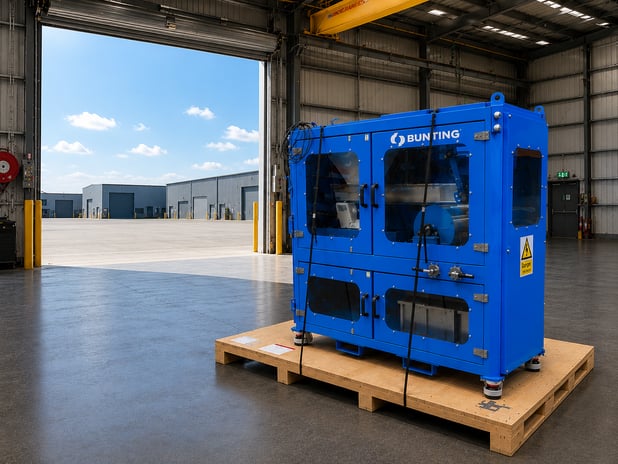
Bunting supplied an ESS 30 Laboratory ElectroStatic Separator designed specifically for research and material analysis applications.
The system separates conductive and non-conductive particles by applying an electrostatic charge, enabling researchers to study material behavior and evaluate separation efficiency.
Its compact design makes it idea for laboratory use, complete with a machine mounted control panel, vibratory feeder and collection bins housed within an interlocked safety encloser, while providing the flexibility needed for testing and process validation.
SYSTEM DESIGN
Designed for precision, flexibility, and repeatable testing.
Researchers can adjust operating parameters, process small material samples, and observe separation behavior under controlled conditions.
The ESS 30 Laboratory ElectroStatic Separator enables:
-
Controlled separation testing on small batches
-
Evaluation of conductive and non-conductive materials
-
Process development before production-scale investment
-
Repeatable testing for material analysis and validation
RESULT
The system provided repeatable separation testing in a controlled laboratory environment.
This enables researchers to evaluate material behavior, optimize separation parameters, and reduce uncertainty before scaling processes to production.
By validating separation performance at laboratory scale, the facility can support more efficient process development and make better-informed equipment decisions.
WHY IT MATTERS
Laboratory testing reduces risk in full-scale process design.
Understanding how materials behave during separation is critical before investing in production equipment. Laboratory-scale testing provides valuable insight into process efficiency, material recovery, and system performance.
Bunting’s laboratory-scale separation equipment allows customers to validate material behavior before investing in production-scale systems.
FREQUENTLY ASKED QUESTIONS
1. What is an ElectroStatic Separator used for?
An ElectroStatic Separator is used to separate conductive materials from non-conductive materials based on electrical charge, commonly in recycling and material processing applications.
2. How does electrostatic separation work?
Electrostatic separation works by applying a charge to particles. Conductive materials lose their charge quickly and separate differently from non-conductive materials, enabling effective separation.
3. What is a laboratory ElectroStatic Separator used for?
A laboratory ElectroStatic Separator is used to test and evaluate how conductive and non-conductive materials separate under controlled conditions before scaling to full production.
4. Why use a laboratory-scale separator?
Laboratory-scale systems allow researchers to test and refine separation processes using small material samples before scaling up to full production.
5. What materials can be separated using electrostatic technology?
Electrostatic separators are commonly used to separate metals from plastics, recover fine conductive particles, and process materials such as electronic waste and mineral sands.